Backlit mirror power draw vs circuit load: the RCP coordination note for Sarjapur Road electricians
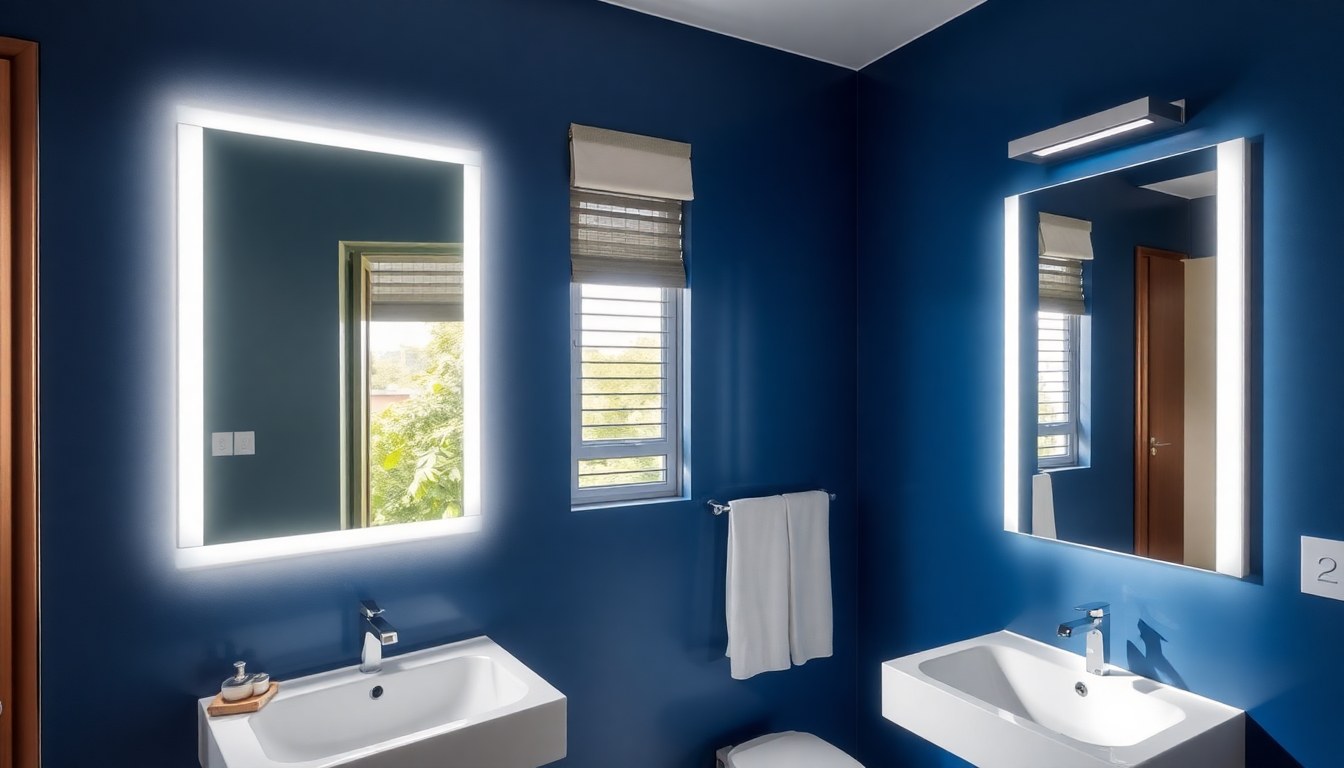
A backlit mirror draws 40–60W depending on LED array size and colour temperature. On a Sarjapur Road residential build with three mirrors in a shared bathroom vanity, that load compounds. Most architects specify the mirror, hand the electrical RCP to the consultant, and assume the circuit is adequate. It often isn't. The gap between mirror specification and circuit load calculation is where punch-list delays happen.
Why backlit mirror power matters on the RCP
Backlit mirrors are no longer a luxury add-on in Bangalore's tech-corridor housing stock—they're a standard spec in HSR Layout, Koramangala, and Indiranagar projects. Unlike a passive mirror, a backlit unit draws continuous load during use. A rectangle LED mirror with a 1200 × 600 mm footprint and warm white (3000K) LEDs pulls approximately 50–55W at full brightness. Smaller units, like our 30" × 22" capsule LED mirror, sit at 40–45W. A larger 36" × 24" capsule reaches 55–60W.
The issue arises when the electrical consultant designs the bathroom circuit without knowing the mirror specification. A standard 16A bathroom circuit (2.4 kW at 230V) can nominally handle multiple mirrors, but only if no other loads run simultaneously. In practice, on a Sarjapur Road build in a three-bed villa or apartment, the bathroom vanity often shares circuit load with the exhaust fan (40–80W), the geyser (2–3 kW if instant), and sometimes a heated towel rail (300–500W). Suddenly, the 16A circuit is under-spec'd, and the electrician's RCP shows an overload condition that wasn't caught at design stage.
Load calculation: single mirror vs multi-mirror coordination
Start with the basics. IS 2553:2013 (Code of Practice for Electrical Installation in Buildings) requires that every bathroom circuit be independently calculated based on connected load, not assumed load. A connected load is the sum of all electrical equipment that could run at the same time on that circuit.
For a single backlit mirror on a dedicated circuit: 50W is negligible. A 16A circuit (3.68 kW theoretical capacity at 230V) handles it with ease. But architects rarely specify a dedicated mirror circuit. More often, the mirror shares the vanity lighting circuit with the exhaust fan and possibly the geyser.
For a multi-mirror bathroom—common in Bangalore's premium residential projects where dual vanities are standard—the load compounds. Two backlit mirrors at 50W each = 100W. Add a 60W exhaust fan, a 500W heated towel rail, and you're at 710W on a single 16A circuit. Still within nominal capacity. But the RCP must show this explicitly. If the consultant's RCP lists only the exhaust fan and omits the mirror load, the circuit is under-specified on paper, and the electrician will flag it during site inspection.
Where the coordination gap opens
The gap occurs because mirrors are often specified after the electrical design is locked. An architect finalizes the RCP with the consultant in month 2. The interior designer selects the mirror in month 4. By then, the electrician has already ordered cable and circuit breakers based on the original RCP. When a backlit mirror is introduced, the electrician must either re-route the circuit (cost and delay) or ask the architect to confirm that the original circuit can absorb the new load. If the architect hasn't done the math, the answer is unclear, and the project hits a punch-list hold.
Practical RCP coordination for Bangalore projects
The fix is straightforward: specify the mirror before the electrical consultant locks the RCP. This is particularly critical on Sarjapur Road builds, where the post-tech-boom housing boom has compressed design-to-handover timelines.
At specification stage, provide the electrical consultant with:
- Mirror model and power rating (e.g., 36" × 24" capsule LED mirror, 55W, 230V, 50Hz)
- Number of mirrors per bathroom circuit
- Other connected loads on the same circuit (exhaust fan, towel rail, geyser, etc.)
- Duty cycle assumption (mirrors typically run 5–15 minutes per use, not continuously)
The consultant then calculates the connected load and, if necessary, specifies a 20A circuit instead of 16A, or segregates the mirror onto its own sub-circuit. This is not expensive—it's a cable and breaker change—but it must be decided before the electrical rough-in.
Hard water and LED lifespan: a secondary coordination note
Bangalore's Cauvery water carries a TDS of 200–300 ppm, which deposits mineral scale on mirror surfaces and can degrade LED sealant over time if the mirror is not properly sealed. This isn't a circuit-load issue, but it affects mirror longevity and, indirectly, maintenance load on the electrical circuit (if the mirror fails and is replaced mid-project, the circuit must be re-tested).
Specify mirrors with fully sealed LED modules and PVD-coated brass or stainless-steel frames. Avoid mirrors with exposed solder joints or unsealed connectors. During site handover, include a care note for the end-user: wipe the mirror weekly with a soft, dry cloth; avoid direct water spray on the LED module; and do not use abrasive cleaners. This reduces the risk of premature LED failure and keeps the electrical load predictable.
Monsoon humidity and circuit protection
Bangalore's monsoon season (June–September) brings 80–90% relative humidity into bathrooms, especially in Whitefield and Indiranagar projects where air circulation is limited. High humidity accelerates corrosion of electrical contacts and increases the risk of earth leakage. Ensure the bathroom circuit is protected by a 30mA RCCB (residual current circuit breaker) rated to IS 4167. This is standard practice, but it's worth confirming on the RCP because a backlit mirror with any micro-fault in the LED module will trigger the RCCB—and the electrician needs to know this is expected, not a circuit failure.
Questions architects ask
Can I run two backlit mirrors and a heated towel rail on a single 16A circuit?
Nominally, yes—100W (mirrors) + 400W (towel rail) = 500W, well under the 3.68 kW capacity of a 16A circuit at 230V. However, the RCP must show this explicitly, and the electrician must confirm that no other loads (geyser, exhaust fan) are on the same circuit. If you're uncertain, specify a 20A circuit. The cost difference is negligible, and it avoids a punch-list delay.
Do backlit mirrors need their own dedicated circuit?
Not necessarily. A mirror can share a circuit with low-load devices like an exhaust fan. But if you're specifying a geyser on the same circuit, segregate the mirror onto a separate sub-circuit. Geysers draw 2–3 kW and will dominate the circuit load; adding a mirror to the same circuit complicates the RCP calculation unnecessarily.
What happens if the electrician doesn't know the mirror power rating when he designs the circuit?
He'll assume a standard bathroom circuit (16A) and may under-spec the cable gauge or breaker rating. When the mirror is installed, the circuit may be overloaded on paper, triggering a site inspection hold. Provide the mirror spec to the electrical consultant at RCP stage, not after rough-in.
Does a backlit mirror need a separate isolator switch?
Yes. IS 2553 requires that every electrical load have an accessible isolator or switch within the room. Specify a modular switch socket or a dedicated 1-gang switch for the mirror on the vanity wall, adjacent to the mirror. This allows the user to isolate the mirror for maintenance and gives the electrician a clear point of control on the circuit.
Are there any Bangalore-specific considerations for backlit mirrors?
Two: hard water (TDS 200–300 ppm) accelerates mineral buildup on the mirror surface, so specify fully sealed LED modules and include a care note in the handover document. And monsoon humidity (June–Sept, 80–90% RH) increases earth-leakage risk, so confirm that the bathroom circuit is protected by a 30mA RCCB. Both are standard practice but worth explicit confirmation on the RCP.
Specifying the mirror early saves the electrician a site call
The Sarjapur Road residential boom has compressed project timelines, but the electrical coordination step is non-negotiable. Specify your backlit mirror—whether a rectangle LED mirror or a designer mirror—before the RCP is locked. Provide the power rating, number of units, and connected loads to the electrical consultant. Confirm that the circuit is sized to spec and that an RCCB is in place. This single coordination step eliminates a common punch-list hold and ensures the mirror is ready for handover without electrical delays.
Spec a Bathqube backlit mirror for your next Bangalore project, and request a technical data sheet to share with your electrical consultant. We'll provide the power rating, cable requirements, and installation notes upfront—no surprises on site.

