Frameless vs semi-frameless shower enclosures: glass edge load distribution for 6×3 ft Whitefield baths
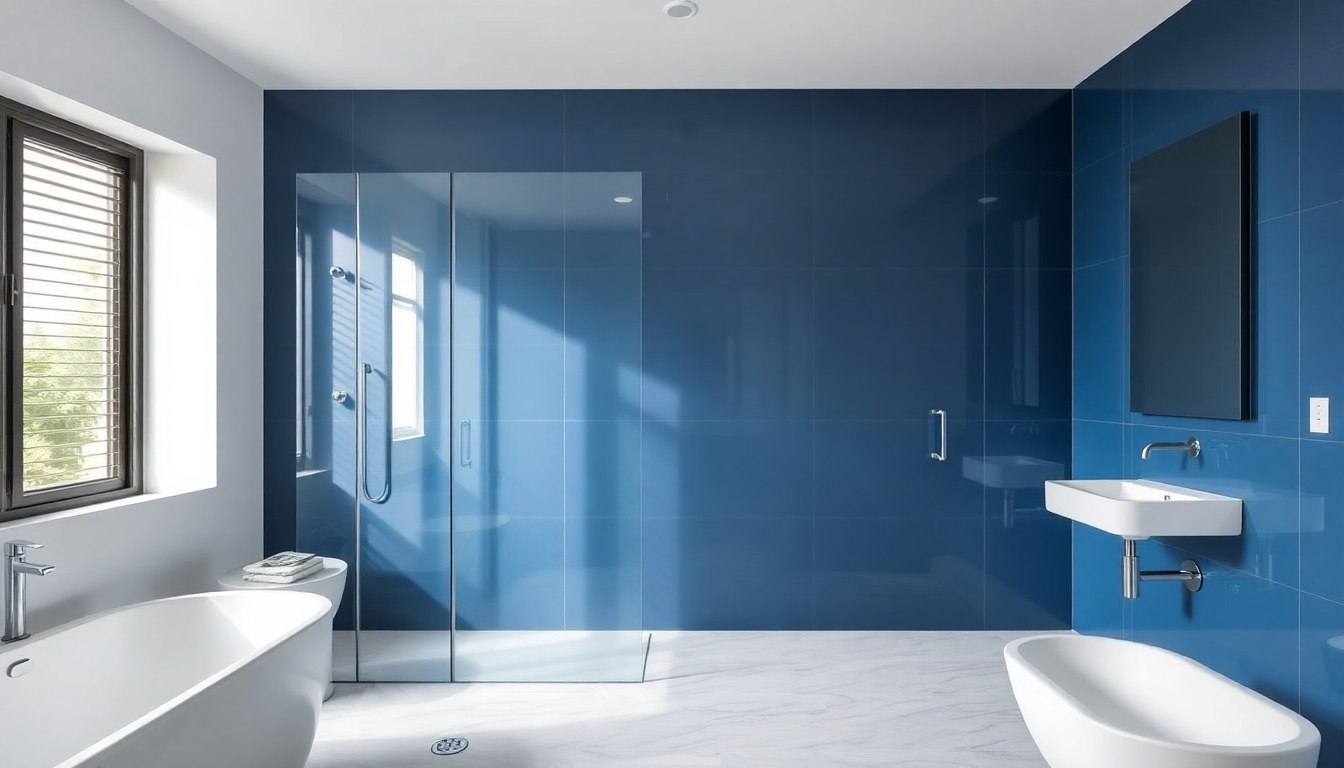
A 6×3 ft master bath in a Whitefield high-rise leaves roughly 1220 mm × 760 mm for a walk-in wet zone—just enough for a single hinged panel and a fixed return. The question at shop-drawing stage is whether to mount that panel as a full cantilever off the fixed glass, or to land the hinge edge on a U-channel frame. The structural difference is not cosmetic: it's a question of where the 12–15 kg door mass sits, how much deflection the hinge line tolerates, and whether the top edge needs a header to keep the assembly square under daily swing cycles.
Cantilever mechanics: how frameless panels distribute hinge load
In a true frameless configuration, the hinged panel mounts directly to the fixed glass via offset pivot hinges—typically three stainless-steel or brass bodies spaced 150 mm from top and bottom edges, with a third at mid-height. Each hinge transfers the door's dead load and swing inertia into the fixed panel, which acts as a vertical cantilever anchored at the floor channel and, if present, a minimal top clamp. The fixed panel must be thick enough to resist bending moment at the hinge line: 10 mm tempered glass is the practical minimum for a 760 mm door width, and 12 mm is specified when door height exceeds 1980 mm or when the client expects heavy daily use.
Deflection at the free edge of a 10 mm × 1980 mm × 760 mm panel under a 14 kg door load is on the order of 2–3 mm, within the elastic range of tempered glass but enough to produce visible gap variation at the sweep seal. The hinge hardware itself must accommodate this deflection: quality pivot sets include spring-loaded cam mechanisms that maintain seal pressure as the fixed panel flexes. Cheaper two-piece clamp hinges lock the door rigidly to the fixed glass, transmitting every swing impulse as shear stress at the hinge bore—a common origin of star cracks in under-specified installations.
Top clamp vs no top support
Some frameless specs omit the top stabiliser bar entirely, relying on floor-channel rigidity and hinge strength alone. This works in a 1980 mm height if the fixed panel runs wall-to-wall and both vertical edges are silicone-bonded to tile, effectively creating a three-edge support condition. In Whitefield projects where the fixed panel is an island return—one edge open—a minimal top clamp (15 mm × 15 mm stainless angle or a glass-to-glass bracket) prevents the panel from rotating out-of-plane when the door swings. The clamp adds 600 grams and introduces two more drill points, but it halves deflection at the hinge line.
Semi-frameless edge support: U-channel load path
A semi-frameless enclosure lands the hinged panel's vertical edge into an extruded aluminium U-channel—typically 20 mm × 25 mm in section, powder-coated or anodised, with a neoprene glazing gasket. The channel is wall-fixed at 300 mm centres with stainless screws into tile backer or blockwork, so hinge loads transfer directly to structure rather than cantilevering off the fixed glass. The fixed panel still needs floor anchorage and a top rail (or wall return) to stay plumb, but it no longer functions as a structural beam.
This load path reduces glass thickness requirements: an 8 mm tempered panel is adequate for the fixed return because it carries no hinge moment, only its own weight and wind load from bathroom exhaust pressure differentials. The hinged door itself can also be 8 mm if the U-channel is stiff enough—aluminium extrusions above 2 mm wall thickness meet that threshold. Total enclosure weight drops by 8–10 kg compared to a 10 mm + 10 mm frameless pair, a meaningful reduction when the floor is a post-tensioned slab with tile-over-waterproofing and you're chasing every kilogram in the RCP coordination.
Tolerance stack-up and site adjustment
The U-channel introduces a tolerance variable: wall plumb. If the Whitefield site's blockwork is 4 mm out-of-plumb over 2100 mm height—not unusual in fast-track projects—the channel must either be shimmed or the glass panel cut slightly under-width to fit the resulting trapezoidal opening. Frameless enclosures tolerate wall irregularities better because the fixed panel is silicone-bedded with a 3–5 mm joint line that compresses to accommodate tilt. Semi-frameless specs should call for a site check-measure before glass fabrication, and the shop drawing should note a ±3 mm width tolerance to give the installer wiggle room.
Hinge mounting: torque, bore diameter, and edge distance
Hinge hardware for 10 mm glass uses an M8 or M10 through-bore with nylon or EPDM isolation sleeves to prevent point loading. The bore is drilled 25–30 mm from the vertical edge of the panel; any closer and the residual edge compression from tempering is insufficient to resist the hinge's clamping torque, especially under repeated swing cycles. Bathqube's hinge sets are torqued to 4–5 Nm at installation and include spring washers to maintain preload as the nylon sleeve creeps.
In semi-frameless doors, the hinge often mounts to the U-channel's inner face rather than boring through the glass. This eliminates the drill operation and its attendant risk of micro-cracks, but it moves the pivot axis outward by the channel width—typically 20 mm—which increases the door's swing radius and may clip a wall-mounted tap or towel bar if the bath is tight. The shop drawing must show the door in 90° open position with all fixtures plotted; in a 6×3 ft Whitefield layout, that often means relocating the hand-shower holder 100 mm further along the wall.
Glass deflection under daily load cycles
Tempered glass is elastic to roughly 60 MPa surface stress, well above the 8–12 MPa induced by a 14 kg door swinging on a 760 mm lever arm. The deflection is reversible, but the silicone joint at the fixed panel's wall junction sees cyclic shear. After 5000–7000 swing cycles—about eighteen months of family use—the joint may develop a 0.5 mm gap at the top corner where deflection is greatest. This doesn't compromise waterproofing if the joint was originally 5 mm wide and filled to the correct depth (half the width, per IS 9042 for structural silicone), but it becomes visible as a hairline shadow.
Semi-frameless enclosures transfer less cyclic stress to the silicone because the hinged panel's load goes into the channel, not the fixed glass. The fixed panel still deflects slightly under its own weight and any impact load (a client leaning against it), but the amplitude is lower. In practice this means the semi-frameless joint may hold its original appearance for 24–30 months before any touch-up is needed. For architects specifying high-use guest suites or rental units in Whitefield's co-living clusters, that durability delta matters.
BIS compliance and load testing
IS 2553 Part 1 requires tempered glass for wet-area enclosures and specifies a minimum edge finish quality (arrised to 1 mm radius) to prevent stress concentration. The standard does not prescribe a deflection limit for shower panels, but IS 800 (steel structures) and IS 456 (concrete) both use span/250 as a serviceability deflection cap; applying that heuristically to a 1980 mm glass panel gives roughly 8 mm, comfortably above the 2–3 mm observed in a properly specified frameless enclosure.
Bathqube's enclosures are tested to a 50 kg point load at mid-height of the fixed panel—roughly four times the actual hinge load—with deflection measured at the free edge. Panels that deflect beyond 5 mm under that test load are re-specified to the next thickness or given additional top support. The test rig is a simple cantilever frame with a spring scale and dial gauge; it's not an accredited lab setup, but it's reproducible and gives a go/no-go decision before the unit leaves the factory floor.
Specification decision tree for compact Whitefield baths
For a 6×3 ft master bath, the choice between frameless and semi-frameless hinges on three variables: ceiling height, wall plumb, and client tolerance for maintenance. If the ceiling is 2700 mm or lower and the walls are plumb within 3 mm, a frameless enclosure with 10 mm glass and a minimal top clamp delivers the clean sight-line most clients expect and requires no channel coordination with tile joints. If walls are >3 mm out, or if the client is a landlord specifying for a rental unit where joint touch-up is unlikely, a semi-frameless U-channel absorbs the site tolerance and isolates the hinge load, at the cost of a 20 mm vertical reveal.
In either case, the floor channel must be anchored into structure—not just tile adhesive. Whitefield high-rises typically have 150 mm screed over slab; the channel's fixing screws should penetrate at least 40 mm into the structural slab, with chemical anchors if the screed is lightweight AAC-aggregate. The shop drawing should call out anchor type and spacing; site teams often default to plastic plugs into screed, which pull out under the panel's overturning moment within six months.
Questions architects ask
Can I spec 8 mm glass for a frameless enclosure to save weight on a post-tensioned slab?
Not for the hinged panel. An 8 mm door will deflect 4–5 mm at the hinge line under its own swing inertia, enough to fatigue the hinge bore and produce a visible gap at the sweep. The fixed panel can be 8 mm if it's a simple wall-return with no hinge load, but the door should remain 10 mm. Total weight difference between an all-10 mm and a 10+8 mm pair is about 6 kg—unlikely to govern slab design in a residential project.
What's the lead time difference between frameless and semi-frameless?
Frameless units require three hinge bores per panel, each CNC-drilled and inspected; semi-frameless doors often mount without boring the glass. If the U-channel is a standard anodised extrusion, lead time is identical—7 to 10 working days. If the channel is powder-coated to a custom RAL, add three days for batch coating. The longer pole is always site measurement: frameless tolerates rough dimensions, semi-frameless needs a final check-measure after tile is done.
Do semi-frameless enclosures need a top rail, or can the fixed panel cantilever like a frameless one?
The fixed panel still benefits from a top rail or wall clamp to prevent out-of-plane rotation, especially if it's taller than 2100 mm. The U-channel on the hinged side doesn't brace the fixed panel—it only supports the door. A minimal 15 mm stainless angle at the top, or a glass-to-glass bracket if the fixed panel meets a return at 90°, is enough. Omit it only if both vertical edges of the fixed panel are bonded to walls.
How do I detail the U-channel joint line with 600×600 mm wall tile in a Whitefield spec?
Align the channel's outer face with a tile joint wherever possible, so the channel's return leg sits behind the tile edge and the vertical grout line dies into the channel. If that alignment doesn't work—tile layout is already locked by a feature wall or niche—run the channel over the tile face and caulk both edges with neutral-cure silicone in a colour matched to the grout. The shop drawing should show the channel position relative to tile grid; site teams will otherwise place it by eye, and you'll get a 15 mm offset that looks unfinished.
What's the maintenance difference over five years?
Frameless enclosures may need silicone joint touch-up at the fixed panel's wall junction after 18–24 months if the client uses the door heavily. Semi-frameless units push that interval to 30 months because hinge loads don't cycle through the fixed glass. Both configurations need annual hinge lubrication—a drop of silicone grease on each pivot pin—and both accumulate limescale at the bottom seal if Cauvery water isn't softened. The U-channel's powder coat can chip if struck; frameless hardware is all stainless and won't corrode, but the hinge bores can develop hairline radial cracks if over-torqued at installation.
Spec a Bathqube enclosure for your next Whitefield project through the online configurator, or request a site-measured shop drawing by sending as-built dimensions and an RCP extract to the technical team.


