Pivot hinge offset for 900mm wide shower doors: the 40mm rule for Domlur alcove installs
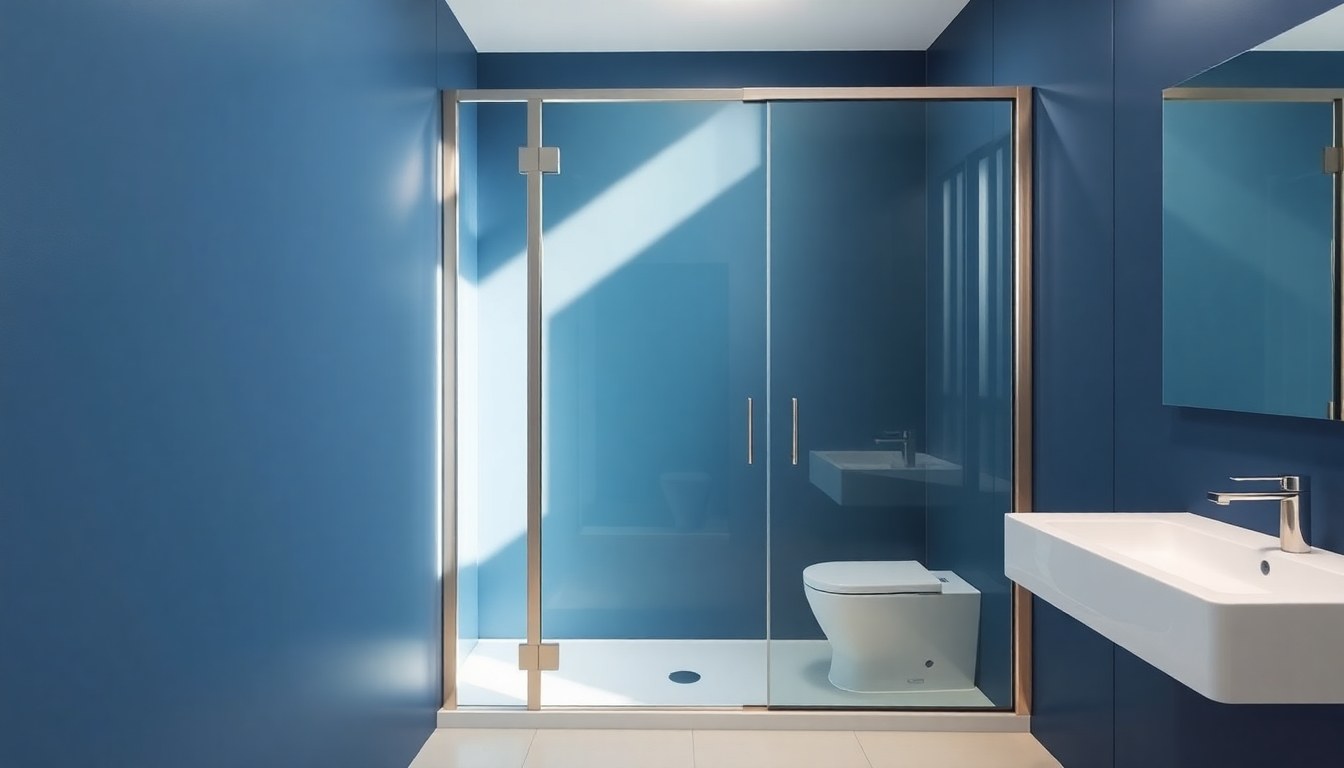
A 900mm-wide pivot door mounted flush to the alcove frame will bind against the side wall at 60° of swing — before the door opens far enough to let anyone through. The problem isn't the door width or the glass thickness; it's hinge offset. In alcove enclosures common to Domlur and Whitefield three-bedroom layouts, the distance between hinge centreline and the fixed panel determines whether the door arcs cleanly or scrapes tile. Architects specifying pivot enclosures for 900mm openings need to hold a 40mm minimum offset from the hinge axis to the inside face of the fixed glass or wall return. Miss that dimension and the door fouls before it reaches 75° — the practical minimum for comfortable entry.
Why hinge offset matters in alcove geometry
Pivot hinges rotate the door panel around a vertical axis set inboard from the door edge. That offset — typically 20 to 50mm — means the door's outer edge scribes an arc wider than the door itself as it swings. In an alcove install, the fixed side panel or tiled return wall sits perpendicular to the door's swing plane. If the hinge is too close to that fixed boundary, the door's trailing edge strikes the wall before the door opens wide enough to pass through.
The geometry is simple: a 900mm door with a 25mm hinge offset scribes an arc radius of 925mm from the hinge centreline. If the fixed panel stands 30mm from that centreline, the door edge will contact the panel at roughly 62° of swing. For comfortable ingress, you need 75° minimum — which requires the fixed boundary to sit at least 40mm from the hinge axis. Architects working with as-built dimensions in older Koramangala flats often discover this gap during shop-drawing review, when the alcove width is fixed and the hinge spec hasn't been called out.
The 75° threshold for body clearance
A human shoulder span is approximately 450mm. To pass through a doorway without turning sideways, the effective clear width must exceed 500mm. A 900mm door at 75° of swing yields roughly 520mm of clear passage when you account for the frame projection and the door thickness. Below 70°, that width drops to 480mm — tight enough that most users instinctively turn their shoulders, which reads as poor detailing on the punch list. The 40mm offset rule ensures the door reaches 80° comfortably, giving 550mm clear and eliminating the squeeze.
Calculating offset for 900mm doors in Bangalore alcove dimensions
Standard Bangalore alcove widths for three-fixture bathrooms range from 1200mm to 1500mm. In a typical 1350mm alcove, the enclosure spec might call for a 300mm fixed panel, a 900mm door, and a 150mm fixed return — totalling 1350mm of glass and frame. The hinge mounts on the door edge adjacent to the 300mm panel. If you specify a 25mm hinge offset and mount the fixed panel directly against the side wall, the hinge centreline sits 25mm from the panel's inside face. The door will bind at 62°.
To hit the 40mm rule, you have three options: increase the hinge offset to 40mm (some hardware allows this, but knuckle projection grows and the door feels less stable); shift the entire enclosure 15mm toward the opposite wall, creating a 15mm gap behind the fixed panel (acceptable if you can pack the U-channel with silicone, but it complicates the shop drawing); or reduce the fixed panel width to 285mm and allocate the saved 15mm to hinge clearance. The third option is cleanest — it keeps the hinge at 25mm offset, places the fixed panel 40mm from the hinge centreline, and maintains symmetry.
Tolerance stack-up and site variance
Alcove walls in Bangalore are rarely plumb within 3mm over 2100mm height, and tile finish adds another ±2mm. If your shop drawing assumes perfect 90° corners and you hold the 40mm offset to the nominal dimension, you may find the actual clearance is 37mm after tile. Specify 45mm nominal offset in the RCP and note "verify as-built before glass fabrication" on the drawing. That 5mm buffer absorbs normal site variance without forcing a re-measure or a field modification.
Hardware constraints: knuckle projection and load rating
Pivot hinges for 10mm toughened glass typically support 40kg per hinge pair. A 900mm × 2000mm panel weighs approximately 45kg, so the hinge is near its rated limit. Increasing the offset from 25mm to 40mm moves the door's centre of gravity farther from the hinge axis, increasing the bending moment on the mounting screws. Some economy hardware rated for 25mm offset will flex or sag when pushed to 40mm, especially under Bangalore's June–September humidity when timber door frames swell and the hinge mounting loosens.
Bathqube enclosures use stainless-steel pivot hinges with a 30mm offset and a 50kg load rating, certified to IS 4992. The knuckle projects 35mm from the door face, which is acceptable in most alcove installs. If your site has a recessed alcove with a 50mm-deep niche for the enclosure, verify that the knuckle projection plus the door thickness (10mm glass + 5mm for the hinge plate) doesn't exceed the niche depth. In Jayanagar walk-up renovations where the alcove is formed by a partition wall rather than structural masonry, confirm that the wall can take the hinge load — 50kg concentrated over two M8 screws requires solid blocking or a steel stud, not just plasterboard.
PVD coating and hinge maintenance in hard-water areas
Cauvery water in Bangalore averages 250 ppm TDS. Hinges mounted inside the shower enclosure see daily exposure to mineral-laden spray. Chrome-plated brass hinges pit within eighteen months; the plating delaminates and the brass beneath corrodes, eventually seizing the pivot. PVD-coated stainless hinges hold up better — the coating is harder and the substrate doesn't corrode. Specify PVD if the enclosure will see daily use; accept that even PVD will show water spots unless the user squeegees after each shower. Include "wipe hinge knuckle weekly" in the handover maintenance sheet.
Frame interference and U-channel depth
Alcove enclosures typically mount the fixed panels in a U-channel anchored to the side walls. The channel depth is 12 to 15mm, and the glass sits 2mm proud of the channel face to allow for silicone sealing. If the hinge offset pushes the door edge close to the U-channel, the door may contact the channel lip during swing. This happens when the architect specs a tight alcove fit — say, 1350mm glass in a 1360mm alcove — and the installer packs the U-channel flush to the wall to avoid a visible gap.
The fix is to recess the U-channel 3mm from the finished tile face, so the channel doesn't project into the door's swing arc. Mark "U-channel set back 3mm from FFL" on the shop drawing. The glass will still seal against the channel with a 5mm silicone bead, and the door clears. In Indiranagar apartments where the alcove walls are older terrazzo or Kota stone, you may need to rout a shallow chase for the channel rather than surface-mounting it; surface-mount on irregular stone can leave the channel proud by 5mm, enough to foul the door.
Specifying hinge offset in the RCP and shop drawing
Most enclosure vendors assume a default hinge offset — usually 25mm — unless you call it out explicitly. If your alcove geometry requires 40mm, note "pivot hinge offset 40mm min. from fixed panel inside face" in the general notes on the reflected ceiling plan. Include a detail section showing the hinge centreline, the door swing arc at 80°, and the clearance dimension to the fixed panel. Mark the dimension as "hold" rather than "reference" so the fabricator knows it's critical.
On the shop drawing, ask the vendor to overlay the door swing arc and flag any conflicts with the U-channel, the side wall, or the threshold. A competent fabricator will catch a 38mm clearance and query it before cutting glass; a less careful one will build to the nominal dimension and discover the bind on site. Require the shop drawing to show hinge offset, swing arc, and clearance as separate call-outs, not buried in a general tolerance note.
Field verification before glass order
Even with a good RCP, site dimensions drift. Tile thickness, plaster skim coat, and out-of-plumb walls can shift the alcove width by ±10mm from the architectural drawing. Before the glass is cut, send the installer to verify the as-built alcove width at three heights — 300mm, 1050mm, and 1800mm above FFL — and confirm that the walls are plumb within 3mm. If the alcove tapers, you may need to adjust the fixed panel width or accept a slight taper in the door swing clearance. Catching this before fabrication saves a costly re-cut.
Questions architects ask
Can I use a 20mm hinge offset to gain more door width in a narrow alcove?
You can, but the door will bind earlier in its swing. A 20mm offset in a 900mm door means the hinge centreline is only 20mm from the door edge, so the swing arc radius is 920mm. If your fixed panel is 40mm away, the door clears — but if the panel is 35mm away (common in tight alcoves), the door binds at 68°. You also lose structural stability: a 20mm offset puts more bending load on the hinge, and the door may sag over time. Better to reduce the door width to 850mm and hold a 25mm offset than to push the hinge inboard and risk binding or sag.
What if the alcove is out of square by 8mm over 1350mm width?
An 8mm taper over 1350mm is roughly 0.3°, which is noticeable but manageable. Measure the alcove width at the hinge side and at the opposite side. If the hinge side is narrower, the door will have more clearance as it swings (because the taper opens the gap); if the hinge side is wider, the door will have less clearance. In the second case, calculate the offset based on the narrowest dimension. You may need to scribe the fixed panel to follow the taper, or accept a 5mm silicone joint that varies in width. Mark "verify taper and adjust fixed panel width" on the shop drawing.
Does glass thickness affect the required offset?
Not directly, but thicker glass is heavier, which increases the bending load on the hinge. A 12mm door weighs roughly 55kg versus 45kg for 10mm. If you're specifying 12mm glass for a tall enclosure (say, 2100mm height), confirm that the hinge is rated for the load and the offset. Some 50kg-rated hinges are tested at 25mm offset; pushing to 40mm may exceed the moment capacity. Ask the hardware supplier for the load rating at the specified offset, or step up to a heavy-duty hinge rated for 60kg.
Can I mount the hinge on the opposite side to avoid the fixed panel?
Yes, if the alcove layout allows it. Mounting the hinge adjacent to the open side (the side without a fixed panel) eliminates the clearance problem, because the door swings into open space rather than toward a wall. The trade-off is that the door now swings outward into the bathroom, which may interfere with the vanity or the toilet. In a typical 1800mm × 2400mm Bangalore bathroom, outward swing often works better anyway — it keeps water inside the alcove and gives you more dry floor space. Check the door swing arc against the vanity and the toilet centreline before committing.
How do I detail the threshold to avoid water leakage with a pivot door?
Pivot doors don't seal as tightly as sliding doors because there's no bottom track — just a small pivot cup in the threshold. Water can seep under the door edge during a shower. Detail a sloped threshold (1:50 slope toward the drain) and a 10mm-high water dam on the outboard side of the pivot cup. The dam keeps standing water from migrating into the dry zone. Use a single-piece stone threshold rather than tile — tile joints at the pivot cup will leak. In Whitefield villas with large-format porcelain tile, you can cut a threshold from the same tile, but make sure the cut edge is polished and the pivot cup is bedded in silicone, not just grouted.
Spec a Bathqube enclosure for your next Bangalore project
Bathqube pivot enclosures are engineered with 30mm hinge offset, 50kg load-rated stainless hardware, and BIS-certified 10mm toughened glass. We template to your as-built dimensions and provide a shop drawing with hinge clearance and swing arc called out before fabrication. For alcove installs in Domlur, Koramangala, or Whitefield, request a site measure and a configurator quote through the Bathqube catalogue.


