Towel bar cantilever load: the 15 kg test for wall-mount brass fittings in Hennur villas
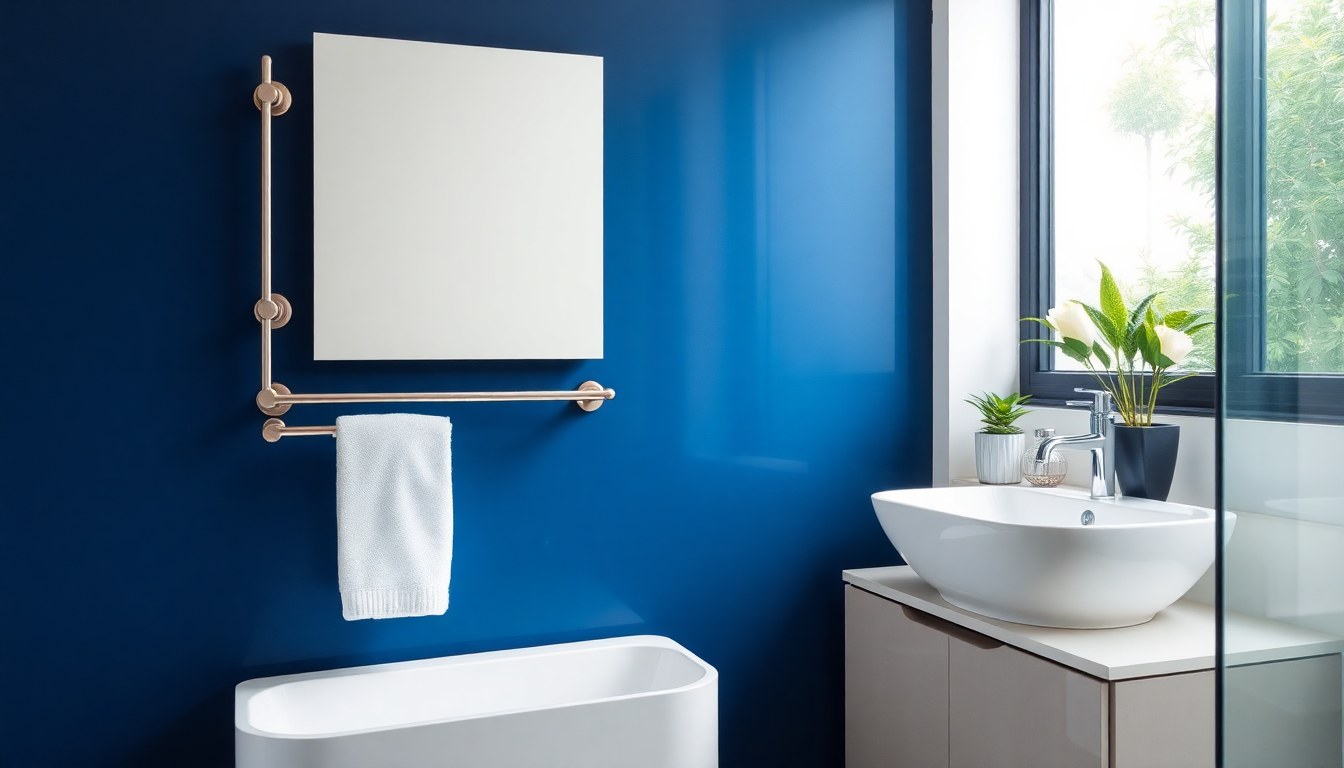
A 600 mm brass towel bar cantilevered 80 mm from a hollow-block wall will fail under 8 kg if the anchor seats in plaster alone—typically within the first six months of occupancy, often during punch-list walkthroughs when the homeowner tests every fixture. The failure mode is predictable: the top fastener pulls free, the bar pivots downward, and the ceramic wall tile cracks in a radial pattern around the lower mounting plate. For interior designers working on Hennur and Devanahalli villa projects where hollow-block construction is standard, specifying accessories isn't about finish alone—it's about understanding cantilever mechanics, substrate density, and anchor embedment depth.
Why 15 kg is the minimum rated load for bathroom accessories
The 15 kg threshold comes from IS 3537 Part 4, which governs sanitary appliances and accessories. A wet bath towel weighs roughly 1.2 kg; two towels plus lateral pull force during removal generates peak loads between 8 and 12 kg at the mounting flange. Add a 25 percent safety margin and you arrive at 15 kg as the minimum tested load for residential bathroom fittings. Most brass towel bars sold in Bangalore carry no load certification at all—the product literature lists material and finish but omits pull-out strength, shear rating, or anchor specification.
When you specify accessories for a Whitefield apartment or a Sarjapur Road duplex, you're designing for a 10-year service life under Cauvery hard water (TDS 200–300 ppm) and monsoon humidity that peaks above 80 percent from June through September. Brass oxidizes, plating delaminates, and fasteners corrode—but the primary failure mode remains mechanical: insufficient anchor depth in low-density substrate. A fitting that passes the 15 kg static test in the factory will still fail on site if the installer seats the anchor in 12 mm of plaster over hollow block instead of driving it 40 mm into the block core.
Anchor embedment and wall substrate: the site variables that matter
Bangalore residential construction uses three primary wall systems: 200 mm solid-concrete block, 150 mm hollow concrete block (most common in villa projects), and 100 mm AAC block in apartment infill walls. Each substrate has a different compressive strength and anchor pull-out resistance. Solid concrete block delivers 8–10 MPa; hollow block ranges from 4–6 MPa; AAC sits at 3–4 MPa. A nylon expansion anchor rated for 15 kg in solid concrete will support less than 8 kg in AAC unless embedment depth increases from 35 mm to 50 mm.
The second variable is plaster thickness. Bangalore masons typically apply 12–15 mm of cement-sand plaster (1:4 mix) over blockwork. Plaster alone has negligible pull-out strength—an anchor seated entirely in plaster will fail under 3 kg. The anchor must penetrate the structural substrate by at least 30 mm to develop rated load. This means the installer needs to drill through plaster, through tile adhesive and tile (another 10–12 mm), and 30–40 mm into the block itself—total hole depth 55–65 mm. Most accessory kits ship with 40 mm anchors and no site-specific installation drawing, leaving the plumber to guess.
Cantilever projection and moment arm
A towel bar is a cantilevered beam. The longer the projection from the wall face, the greater the bending moment at the mounting flange. A bar mounted 60 mm from the wall generates half the moment of one mounted 120 mm out, for the same applied load. In Hennur villas where master bathrooms often feature deep vanity counters (600–650 mm), designers sometimes spec towel bars on the side wall with 100+ mm projection to clear the counter edge. That projection doubles the stress on the anchor compared to a standard 60 mm wall bracket, and the fastener must be sized accordingly—either larger diameter, deeper embedment, or a switch from nylon to metal expansion anchors.
Material and finish: why PVD-coated brass outlasts chrome plate
Brass is an alloy of copper and zinc; the ratio determines hardness and corrosion resistance. Bathroom-grade brass typically runs 60–65 percent copper, 35–40 percent zinc (often called CuZn35 or CZ108). The raw casting is then finished—either electroplated with chrome or nickel, or PVD-coated. Chrome plating deposits a thin layer (5–10 microns) over a nickel base coat; the chrome is hard and bright but vulnerable to pitting in high-chloride environments. Cauvery water carries 30–50 ppm chloride, enough to initiate localized corrosion at plating defects within 18–24 months if the fitting isn't rinsed and dried regularly.
PVD coating—physical vapor deposition—bonds a ceramic-metallic layer (typically titanium nitride or zirconium nitride) at the molecular level. The coating is thinner (2–4 microns) but far harder (1500–2000 Vickers versus 800 for chrome) and chemically inert. PVD fittings maintain finish integrity through the 10-year warranty period even in coastal-humidity Bangalore monsoons. When you specify accessories for a Jayanagar or Basavanagudi renovation where the client expects minimal maintenance, PVD is the defensible choice—it costs 20–30 percent more than chrome plate but eliminates the callback for tarnished or pitted fittings at year two.
Installation tolerance and alignment: the RCP coordination step designers skip
Towel bars, robe hooks, and soap dispensers appear on the bathroom elevation but rarely on the reflected ceiling plan or the plumbing coordination drawing. The result: the plumber installs the accessory bracket wherever it clears the tile joint line, often 20–30 mm off the dimension shown on the ID drawing. That misalignment becomes visible when the client hangs the towel and realizes the bar sits 50 mm lower than the adjacent mirror edge, or the robe hook is off-center relative to the shower enclosure frame.
The fix is simple: add accessory mounting heights and centerlines to the RCP or the bathroom shop drawing, and call out ±5 mm tolerance. Mark the anchor location before the tile goes up, so the mason can leave a small recess or use a tile with a factory-drilled hole if the design requires precise alignment. For projects with wall-mount glass soap dispensers and matching robe hooks, coordinate the mounting plate with the tile module—a 600 × 300 mm tile has joint lines every 600 mm horizontally; if the accessory centerline falls 580 mm from the corner, the installer has to cut tile or shift the bracket.
Vertical spacing and the punch-list walkthrough
Standard mounting heights: towel bar 1100–1200 mm above finished floor, robe hook 1500–1600 mm, towel ring 900–1000 mm. These dimensions assume an adult user and clear space below for a 700 mm-long towel to hang without touching the counter or floor. In compact Koramangala apartment bathrooms (1200 × 1800 mm footprint), vertical spacing tightens—designers often mount the towel ring at 950 mm and the bar at 1150 mm to fit both on a single 600 mm-wide wall section between the vanity and the shower entry. Verify clearance on the as-built before finalizing accessory locations; a dimension that works on the plan may conflict with the electrical conduit or the hot-water line once the wall is closed.
Electric towel warmers: load, wiring, and the Bangalore winter question
Electric towel warmers—wall-mount rails with integrated heating elements—serve two functions: they dry towels faster (useful during June–September monsoon when indoor humidity exceeds 75 percent) and they add 50–80 watts of radiant heat to the bathroom. Bangalore winter mornings (December–January) drop to 15–17 °C; a 24-inch rail towel warmer raises the perceived temperature by 2–3 °C in a 10 sq m bathroom, enough to make the 6 a.m. shower less punishing.
From a specification standpoint, electric warmers require three additional site inputs: a dedicated 230V 5A circuit from the bathroom distribution board, a weatherproof switch located outside the wet zone (minimum 600 mm from the shower enclosure per IS 732), and a wall substrate capable of supporting 8–10 kg static load plus the thermal expansion cycling. The warmer mounts on two brackets spaced 500–600 mm apart; each bracket needs a 50 mm anchor embedment into solid block or a toggle bolt if the wall is AAC. The electrical rough-in must be coordinated with the tile layout so the conduit exit point aligns with the warmer's cord entry—typically bottom-left or bottom-right, 100 mm above the mounting flange.
Questions architects ask
What anchor type should I specify for towel bars in AAC-block bathroom walls?
Metal toggle bolts or nylon anchors rated for low-density substrates, with minimum 50 mm embedment. Standard plastic expansion anchors seat poorly in AAC; the block's cellular structure crushes under load and the anchor pulls free. Toggle bolts spread the load across a larger area on the back side of the block and deliver 12–15 kg pull-out strength. Include anchor specification in the bathroom shop drawing so the installer orders the correct hardware before the tile goes up.
How do I prevent towel-bar mounting plates from cracking the tile during installation?
Drill pilot holes with a carbide-tip masonry bit at slow speed (400–600 RPM) and light pressure. The bit must penetrate tile, adhesive, and plaster before reaching the block substrate—total depth 55–65 mm for a 40 mm anchor embedment. If the installer applies too much pressure or runs the drill too fast, the tile fractures in a radial pattern around the hole. Mark drill depth with tape on the bit shank to prevent over-drilling, which weakens the anchor seat.
Can I mount a towel warmer on the same wall as a recessed shower niche?
Yes, if the niche framing leaves at least 150 mm of solid block between the niche edge and the towel-warmer bracket. The niche typically requires a steel or cement-board frame set 75–100 mm into the wall; that recess reduces the effective wall thickness. Verify the as-built framing before specifying the warmer location—if the wall is too thin, move the warmer to an adjacent wall or switch to a freestanding floor model.
What's the standard warranty on brass bathroom accessories, and what does it cover?
Bathqube accessories carry a 10-year warranty on material, finish, and mechanical function—covering manufacturing defects, PVD coating delamination, and fastener corrosion. The warranty excludes damage from improper installation (insufficient anchor depth, over-torqued fasteners), physical impact, or use of abrasive cleaners. Request a copy of the installation guide with anchor specifications before the site handover; most callbacks trace to incorrect fastener selection or embedment depth, not product defects.
Should I specify wall-mount or countertop soap dispensers for a 1200 mm vanity?
Wall-mount dispensers free up counter space and eliminate the water pooling that occurs around countertop pump bases—important in Bangalore's monsoon months when bathroom humidity stays high. Mount the dispenser 100–150 mm above the counter surface and 200 mm from the basin edge, so the user can pump soap directly into their hand without dripping onto the counter. Coordinate the mounting plate with the tile joint line to avoid cutting a small tile sliver during installation.
Spec a Bathqube accessory set for your next Bangalore bathroom project—open the catalogue at bathqube.com or request a project quote with site dimensions and substrate details. We'll send anchor specifications, mounting-height drawings, and a PVD finish sample for client approval before your punch-list walkthrough.


