Wall-mount faucet rough-in height vs spout projection: the 225mm clearance rule for Jayanagar counter basins
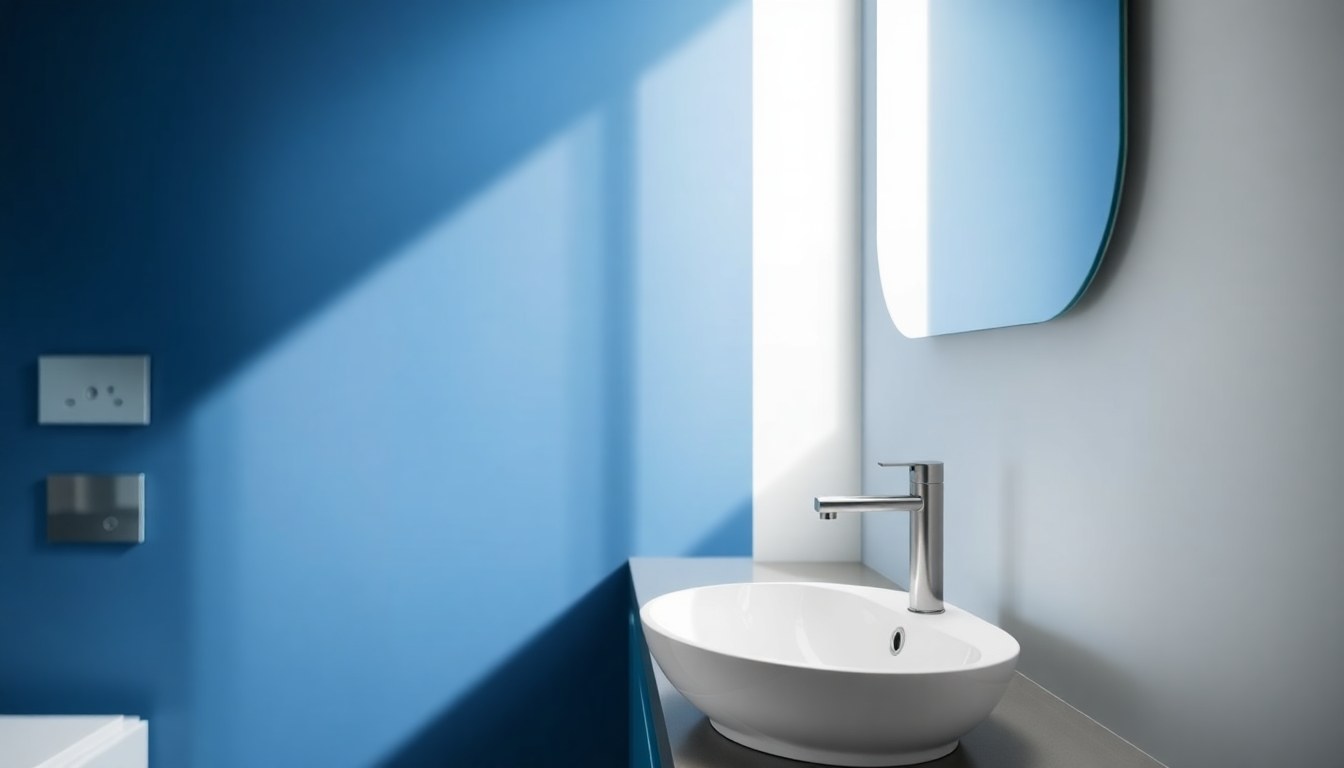
A Jayanagar master bathroom spec crosses your desk: 1200×600 engineered-stone counter, twin under-mount basins, wall-mount faucets for clean horizontal lines. The plumber asks for rough-in height. You measure basin rim at 900mm finished floor level, eyeball 150mm spout projection, and call it good. Three weeks later the homeowner complains water hits the back slope and splashes onto the mirror. The problem isn't the faucet — it's the 75mm you didn't account for between spout tip and basin centre.
Why rough-in height alone doesn't define clearance
Wall-mount faucets mount to a concealed body inside the wall, typically 150–200mm behind finished tile. The spout projects forward; the aerator sits another 20–40mm past the spout nose. Rough-in height — centreline of the supply stub-outs — determines where the spout exits the wall, but usable clearance depends on three dimensions: rough-in height, spout projection, and basin depth. Miss one and you're either splashing the user or forcing them to lean into the counter.
For a typical under-mount counter basin 380–420mm diameter and 150mm deep, mounted with rim at 900mm FFL, a 900mm rough-in centreline with 180mm spout projection leaves approximately 225mm vertical clearance between aerator and basin bottom. That 225mm is the working envelope: enough to wash hands without hitting the spout, tight enough that water doesn't gain velocity and splash the backsplash.
The projection variable
Spout projection isn't standard. A minimal wall-mount spout runs 120–140mm; a long-reach lavatory spout extends 200–220mm. Architects spec long-reach spouts for vessel basins or wide counters where the faucet must clear the front lip, but pair a 220mm spout with a shallow 380mm basin and the aerator sits past the basin centreline — water hits the drain cover directly, and hand-washing happens in a 150mm-radius target zone.
Before you lock rough-in height on the shop drawing, confirm spout projection from the faucet cut-sheet. If the manufacturer lists "projection 180mm," measure from finished tile face (not from centreline stub-out) to aerator tip. That's your horizontal reach. Now subtract half the basin diameter to find how far the spout overhangs the basin centre — that offset determines where the water column lands.
The 225mm clearance rule for Bangalore counter basins
In a Jayanagar or Koramangala villa where counter height runs 850–900mm FFL and basins sit under-mount in 20mm stone, 225mm aerator-to-basin-bottom clearance hits the sweet spot. It's derived from typical hand-washing ergonomics: adult hands need roughly 180mm vertical clearance to cup water without knuckles grazing the basin, plus 45mm buffer for spout swing and aerator maintenance.
Here's the math for a representative installation. Basin rim: 900mm FFL. Basin depth (under-mount): 150mm, so basin bottom sits at 750mm FFL. Target aerator height: 975mm FFL (750 + 225). If the spout body mounts at 950mm centreline and the aerator drops 25mm below the spout centreline, you land at 925mm aerator height — within tolerance. If the spout is a flat horizontal design where aerator aligns with centreline, you'd rough in at 975mm centreline. Either way, you're engineering to the 225mm target, not guessing.
Adjusting for vessel and semi-recessed basins
Vessel basins flip the equation: rim height rises to 950–1000mm FFL, and basin depth drops to 100–120mm because the bowl sits proud of the counter. A 225mm clearance rule still holds, but now you're roughing in at 1075–1125mm centreline for a spout that must clear the vessel rim and land mid-bowl. That's why vessel-basin faucets ship with 200–220mm projection: the spout has to reach over the rim and drop into a smaller target. Spec the rough-in too low and the spout clears the rim by 30mm — functionally useless and impossible to fix without re-plumbing behind tile.
Semi-recessed basins — front half proud, back half inset — sit somewhere between. Rim height typically 920–950mm FFL, depth 130mm, and the faucet mounts on the back wall. Because the user stands closer to a semi-recessed basin, a 200mm spout projection can feel intrusive; 160–180mm works better, and rough-in drops to 920–950mm centreline to maintain the 225mm working envelope.
When the mason's already tiled: the as-built tolerance window
You inherit a Whitefield row-house retrofit. The client wants wall-mount faucets; the tile's already up. You measure stub-out centreline at 880mm FFL — 20mm lower than your 900mm target. The basin is a standard 420mm under-mount, rim at 900mm, depth 160mm, so basin bottom is 740mm. An 880mm rough-in with a drop-spout (aerator 30mm below centreline) puts the aerator at 850mm — 110mm clearance. That's marginal: hands will crowd the spout, and any low-flow aerator with a tall cartridge will sit even lower.
Your options: specify a horizontal-outlet spout where the aerator aligns with centreline (880mm aerator height = 140mm clearance, workable), or surface-mount a deck-plate escutcheon that lifts the spout body 15–20mm and recovers lost height. The escutcheon isn't original spec, but it's faster than chipping tile to re-route supply lines. Document the substitution on the as-built and note the revised clearance on the punch list so the contractor knows the tolerance window closed.
The ±15mm stub-out tolerance
BIS SP 62 (plumbing code) doesn't prescribe lavatory rough-in height; it's site-determined. That means your 900mm dimension on the RCP is a target, not a guarantee. Plumbers typically hold ±15mm on concealed stub-outs if they're setting them before tile. If you need tighter tolerance — say you're pairing a 120mm-projection spout with a shallow 360mm basin and every 10mm counts — call it out on the shop drawing: "Stub-out centreline 900mm FFL ±5mm, verify before tile." The plumber will grumble, but you've documented the requirement.
After tile, measure as-built centreline and confirm aerator height with the actual faucet body before handover. If the dimension drifted and clearance dropped below 200mm, flag it. The homeowner won't notice until they use the basin daily, and by then you're into a warranty argument about whether the faucet or the rough-in is out of spec.
Spout swing and the back-wall clearance problem
Wall-mount faucets with single-lever mixers pivot at the spout base. Swing radius varies — 30° to 90° depending on cartridge design — and the aerator traces an arc. If the basin sits tight against the back wall (common in 600mm-deep counters where the basin is centred), a long-reach spout with wide swing will hit the tile on full rotation. You won't see it on the 3D render, but the site supervisor will when they test the faucet before handover and the aerator scrapes the backsplash.
Specify swing limit on the shop drawing if clearance is tight: "Spout swing ≤60° to avoid tile contact." Some faucet bodies include an internal stop; others rely on the installer setting a field stop with a grub screw. Either way, the dimension belongs on paper before rough-in, not discovered during punch.
Cauvery TDS and aerator maintenance access
Bangalore municipal water averages 200–300ppm TDS, high enough that aerators clog with calcium scale every 8–12 months. Wall-mount faucets bury the supply lines, so aerator access is the only serviceable touch-point. If your 225mm clearance puts the aerator 80mm above the basin rim and the basin is under-mount with a 40mm reveal below the counter edge, the homeowner can unscrew the aerator without a step-stool. Drop clearance to 180mm and they're reaching into the basin at an awkward angle.
Maintenance access isn't glamorous, but it's the difference between a five-minute aerator swap and a service call. When you're setting rough-in height, mentally run the scenario: homeowner stands at counter, reaches up to aerator, unscrews with thumb and forefinger. If that motion requires leaning over the basin or kneeling on the counter, adjust the rough-in up by 20–30mm and recover the clearance with a slightly shorter spout projection.
Questions architects ask
Can I use the same rough-in height for two basins on a shared wall?
Yes, if both basins have identical rim height and depth. If one basin is under-mount 150mm deep and the other is a 120mm vessel, the rough-in heights diverge by 30mm to maintain consistent clearance. Run the math separately for each basin and call out two centreline dimensions on the RCP if they differ. The plumber can stub out at different heights on the same supply run; it's a lateral offset, not a rework.
What happens if the basin gets swapped during procurement and the new one is 20mm shallower?
Your clearance grows by 20mm — basin bottom drops, aerator-to-bottom distance increases. If you were already at 225mm, you're now at 245mm, which is fine. If you were tight at 200mm, you're now comfortable at 220mm. The bigger risk is the opposite swap: spec a 150mm-deep basin, rough in accordingly, then the client upgrades to a 180mm-deep stone-carved basin. Now your 225mm clearance contracts to 195mm and hands start crowding the spout. Lock the basin depth on the shop drawing and make any substitution a change-order with a revised rough-in check.
Do PVD-coated spouts change projection compared to chrome?
No. PVD is a surface finish — typically 3–5 micron coating over brass. It doesn't alter spout geometry. Projection, swing radius, and aerator position remain identical to the chrome version of the same faucet body. What does change: PVD costs 40–60% more and holds up better against Cauvery hard water, so you'll see fewer finish calls during the first two years. Specify PVD for client-facing master baths in Sadashivanagar or Indiranagar projects where the homeowner expects low-maintenance hardware.
Can I field-adjust rough-in height if the stub-out is already set?
Only if the stub-out is still accessible and you're willing to re-route before tile. Once tile is up, the stub-out is fixed. You can swap spout bodies to change projection or aerator drop, but you can't move the supply centreline without demolition. That's why the shop drawing matters: it's your last chance to catch a dimension error before the wall closes.
Is 225mm clearance a BIS requirement or a best-practice guideline?
Best practice. BIS SP 62 specifies trap depth, vent sizing, and supply-line pressure, but it doesn't mandate lavatory faucet clearance. The 225mm figure comes from ergonomic field data and manufacturer recommendations aggregated over hundreds of Bangalore residential installations. Treat it as a starting point: adjust up for tall users or deep basins, adjust down for compact powder rooms where counter depth is constrained. The goal is repeatable, splash-free hand-washing — engineer to that outcome, not to an arbitrary number.
Bathqube faucets are BIS-certified, PVD-coated, and spec'd with projection and aerator-drop dimensions on every cut-sheet. If you're detailing a Jayanagar villa master or a Koramangala row-house retrofit and need rough-in clarity before the plumber sets stub-outs, request a configurator quote with the basin profile and counter height — we'll walk the clearance math and red-line the shop drawing before you issue it for construction.


