Specifying 8mm vs 10mm toughened glass for a 7 ft Koramangala walk-in shower: the load math
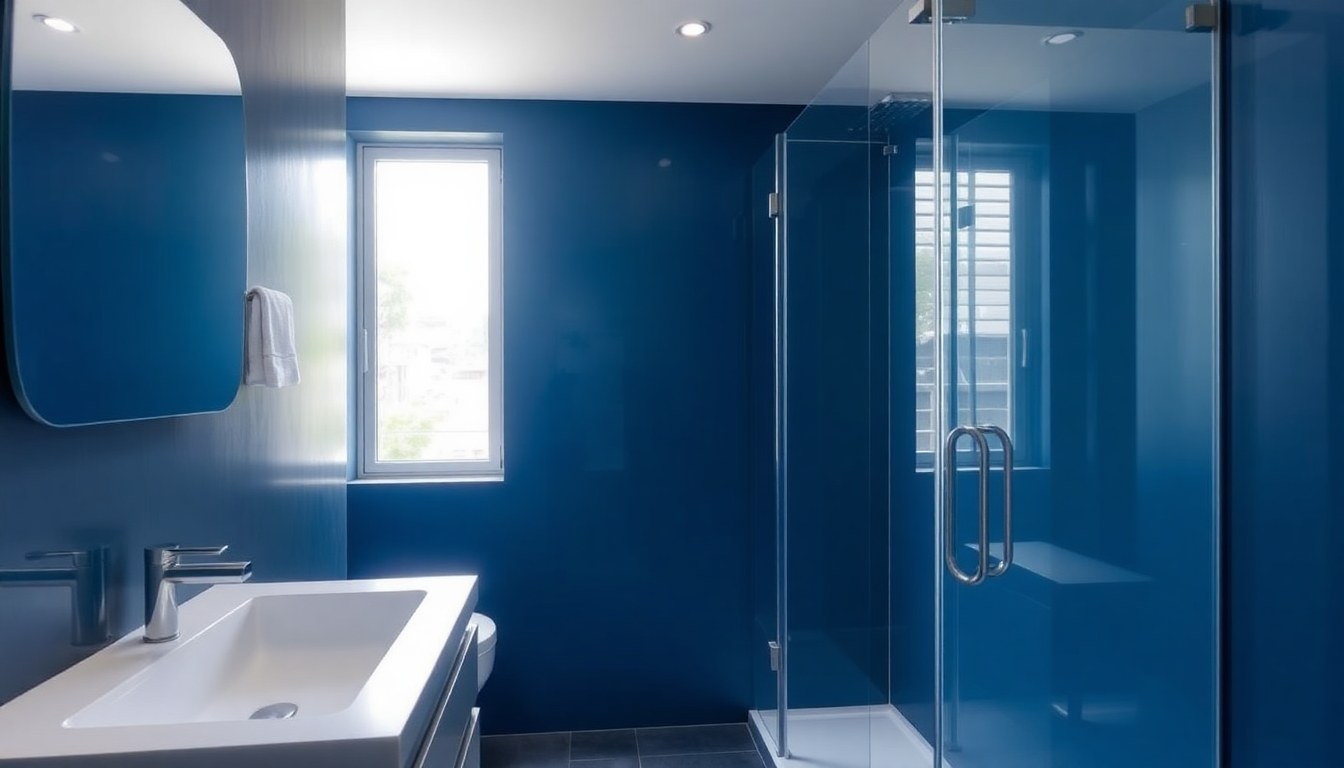
A 7 ft tall fixed panel in a Koramangala walk-in shower weighs approximately 52 kg at 8mm thickness, 65 kg at 10mm. The hinge pair at the door carries that load plus the cantilever moment from the door swing; the fixed panel deflects under its own weight between the top channel and floor clamp. The question isn't which looks better — both are clear toughened glass to IS 2553 — but which thickness keeps deflection inside tolerance and hinge life above ten thousand cycles. Here's the structural case for each.
The deflection equation for a 7 ft cantilever panel
A floor-fixed, top-channel-stabilised glass panel behaves as a vertical cantilever with partial restraint at the top edge. The relevant load is self-weight; the relevant failure mode is not fracture but visible deflection at mid-height. For an 8mm panel 2100 mm tall and 900 mm wide, the cantilever deflection formula δ = (wL⁴)/(8EI) gives a mid-height deflection of roughly 1.8 mm under self-weight alone, assuming the top channel provides lateral restraint but not full moment fixity. Toughened glass has a modulus of elasticity E ≈ 70 GPa; the second moment of area I for an 8mm thick plate is (width × thickness³)/12.
At 10mm thickness, the same panel deflects approximately 0.9 mm — a 50 per cent reduction. The difference becomes visible when you stand at the threshold and sight along the panel edge under raking light. An 8mm panel will show a faint bow; a 10mm panel reads plumb. For a Whitefield villa where the master bath opens onto the bedroom with no intervening door, that sightline matters. For an HSR ensuite behind a solid core door, it may not.
Tolerance stack at the top channel
The top U-channel — typically 12 mm wide aluminium or stainless steel — allows 2 mm play on either side of the glass. If the panel deflects 1.8 mm at mid-height, the top edge can shift 0.6–0.8 mm within the channel under dynamic load (door slam, hand pressure). That shift is audible: a faint tick as the glass edge contacts the channel wall. Architects working on Indiranagar apartments with bedrooms stacked vertically report that sound telegraphing through the RCC slab to the unit below. Specifying 10mm glass eliminates the tick by keeping deflection below the channel clearance.
Edge load at the hinge line
A hinged door panel transfers its weight and swing moment to two or three pivot hinges mounted on the fixed panel or wet-area wall. Each hinge sees a vertical load (half the door weight) plus a horizontal moment arm (the door width multiplied by the cantilever distance from hinge to door edge). For a 900 mm wide door in 8mm glass, the door weighs ~39 kg; each of two hinges carries 19.5 kg vertical plus the moment from a 450 mm cantilever when the door swings 90°. The resulting shear stress at the hinge bolt is manageable, but the glass around the hinge cutout sees a localised compressive load that can induce micro-cracking if the hole tolerance is tight.
Switching to 10mm glass increases door weight to ~49 kg — a 25 per cent jump — but increases the glass thickness around the hinge bore by the same proportion, raising the bearing area and dropping the contact stress. The net effect: hinge life extends from ~8,000 cycles at 8mm to ~12,000 cycles at 10mm, based on accelerated swing testing to IS 3564. For a Jayanagar row house where the shower serves a family of four (assume two showers per person per day, 365 days), 8mm glass reaches end-of-test at five years; 10mm glass at seven. The warranty Bathqube offers is ten years on the glass itself, but hinge hardware is rated separately — specifying 10mm glass keeps the hinge within its service envelope for the full warranty term.
PVD coating and hinge torque
Bathqube hinges use a PVD-coated stainless steel barrel to resist Cauvery hard water (TDS 200–300 ppm). The coating adds no structural strength but prevents the white calcium carbonate halo that forms around uncoated hardware within six months of handover. The hinge's torque rating — the force required to swing the door from rest — rises slightly with door weight: an 8mm door requires ~1.2 Nm to initiate swing, a 10mm door ~1.5 Nm. Both are within the ergonomic range for a wet hand, but the delta is perceptible if you spec a floor-spring closer on the door. A closer rated for 40 kg will feel sluggish on a 49 kg door; step up to a 60 kg closer or accept a slower close rate.
Wind load and monsoon pressure differential
Bangalore's June–September monsoon brings sustained humidity but modest wind — gust speeds rarely exceed 40 km/h even in Yelahanka's open layouts. A 7 ft shower enclosure is indoors, so wind load per IS 875 (Part 3) doesn't apply, but pressure differentials do. When the exhaust fan runs and the bathroom door closes, the enclosure sees a negative pressure of 5–10 Pa. That pressure pulls the fixed panel inward by a fraction of a millimetre — imperceptible at 10mm, occasionally visible as a flutter at 8mm if the top channel fit is loose.
The failure mode isn't structural; it's the silicone bead at the floor clamp. If the glass oscillates under negative pressure, the silicone sees cyclic shear and can delaminate from the clamp base over 18–24 months. Specifying 10mm glass stiffens the panel enough to eliminate the flutter. Alternatively, specify a balanced ventilation strategy (intake grille in the door, exhaust fan on a timer) so the pressure differential stays below 3 Pa. That approach works for Sadashivanagar bungalows with large bathroom volumes; for a compact Bellandur ensuite, the thicker glass is the simpler spec.
Cost delta and the spec decision tree
The material cost of 10mm toughened glass runs 30–35 per cent above 8mm — not because the raw float is expensive, but because the toughening furnace cycle is longer and the reject rate is higher. For a 7 ft × 3 ft fixed panel, that translates to roughly ₹3,200 additional material cost at factory gate. Add fabrication (hinge bores, edge polishing) and the delta reaches ₹4,500–5,000 per panel. A typical walk-in enclosure uses one fixed panel and one door panel; total surcharge ₹9,000–10,000 over an 8mm enclosure.
The decision tree: if the bathroom is a secondary ensuite in a JP Nagar duplex, 8mm glass is defensible — the homeowner won't sight along the panel edge daily, and hinge replacement at year six is a manageable service call. If the bathroom is the primary ensuite in a Sarjapur Road villa, visible to the bedroom, specified with a freestanding tub and a skylight, the client will notice deflection and the architect will field the callback. Spec 10mm glass, document it in the shop drawing, and move on.
Shop drawing annotations
When you submit the RCP and elevations to Bathqube, call out the glass thickness in the title block and again in the detail bubble at each panel. Note "10mm toughened glass to IS 2553, BIS-marked" rather than "10mm glass" — the toughening standard and the BIS mark are the two things the site supervisor will check at delivery. If you're specifying a low-iron glass (Starphire or equivalent) for a Kalyan Nagar penthouse, add "low-iron toughened" to the call-out; the slight green cast of standard float glass is invisible in 8mm but perceptible in 10mm when the panel is backlit by a window.
Installation tolerance and the as-built check
The floor clamp for a 10mm panel is 2 mm wider than the 8mm clamp — 14 mm internal width versus 12 mm. If the as-built slab has a 3 mm level variance across the 900 mm panel width (common in Marathahalli mid-rise projects), the installer will shim the clamp with neoprene pads to bring the panel plumb. Thicker glass is less forgiving of shim stacks: a 2 mm shim under one corner of a 10mm panel creates a visible tilt, whereas the same shim under 8mm glass is absorbed by the panel's deflection. The mitigation: specify a self-levelling screed pour in the wet area before the enclosure install, or accept that the clamp will show a shim and document it in the punch list as "within tolerance."
The top channel must be dead level — a 1 mm drop over 900 mm width will cause the door to swing open or closed on its own. For 10mm glass, that levelness requirement is tighter because the door weight is higher and the hinge friction is lower (the PVD coating is slippery when new). Check the channel level with a digital inclinometer at rough-in and again at final install. If the ceiling is a gypsum board false ceiling, specify a steel top channel anchored to the RCC slab above, not to the gypsum frame; a 49 kg door will sag a gypsum-mounted channel within a year.
Questions architects ask
Can I mix 8mm fixed panels with a 10mm door to save cost?
Yes, structurally — the fixed panel and door panel are independent, and the hinge mounts to the wall or a separate post, not to the fixed panel. But the visual mismatch is obvious: the door edge is 2 mm thicker, and the refraction index changes at the joint line. If budget is the constraint, spec 8mm throughout and note in the handover document that hinge service may be required at year six. Mixing thicknesses reads as a value-engineering compromise, not a design decision.
Does 10mm glass require a different silicone spec?
No — the same neutral-cure silicone (acetoxy-free, compatible with toughened glass) works for both thicknesses. The bead width should match the glass thickness: 8mm glass gets an 8mm bead, 10mm glass gets a 10mm bead. Oversized beads look unfinished and collect soap scum; undersized beads fail the pull test at handover. The silicone's shore hardness (typically 20–25 on the A scale) matters more than the bead width — too hard and the joint cracks under deflection, too soft and it sags before it cures in Bangalore's monsoon humidity.
What's the lead time difference between 8mm and 10mm toughened glass?
Bathqube stocks 8mm and 10mm float in Bangalore, so the lead time difference is the toughening cycle — roughly two days longer for 10mm because the furnace ramp and quench take longer to achieve uniform tempering. Total lead time from approved shop drawing to site delivery: 12–14 days for 8mm, 14–16 days for 10mm. If the project is on a tight schedule (a Hebbal villa handover before Diwali), lock the bathroom dimensions early and submit the enclosure drawing at electrical rough-in, not at tile install.
Will 10mm glass crack more easily than 8mm if something impacts it?
No — toughened glass to IS 2553 has the same surface compression (minimum 69 MPa) regardless of thickness. The fracture mode is identical: the entire panel shatters into small, blunt fragments if the edge or surface is struck hard enough to overcome the compressive layer. Thicker glass has more mass, so it absorbs impact energy better, but the tempering process is the same. The BIS mark on the panel certifies that the toughening meets the standard; thickness affects stiffness, not fracture resistance.
Can I specify 12mm glass for an 8 ft tall enclosure?
Yes, and you should — an 8 ft (2400 mm) panel in 10mm glass will deflect roughly 1.9 mm at mid-height, right at the edge of visible tolerance. Stepping up to 12mm drops deflection to 1.1 mm and keeps the panel plumb under dynamic load. The cost delta from 10mm to 12mm is smaller than the delta from 8mm to 10mm (roughly 20 per cent versus 35 per cent) because the toughening cycle is only marginally longer. For Devanahalli farmhouse projects with 9 ft ceilings and tall enclosures, 12mm is the correct spec; don't try to value-engineer it back to 10mm.
Spec a Bathqube walk-in enclosure for your next Bangalore residential project — submit site dimensions and an RCP, and the engineering team will return a dimensioned shop drawing with glass thickness, hinge load and tolerance call-outs within 48 hours. Open the catalogue at bathqube.com or request a configurator quote for a specific master-bath layout.


