Anti-fog mirror heating film: wattage, placement, and RCP coordination for Malleshwaram steam-prone baths
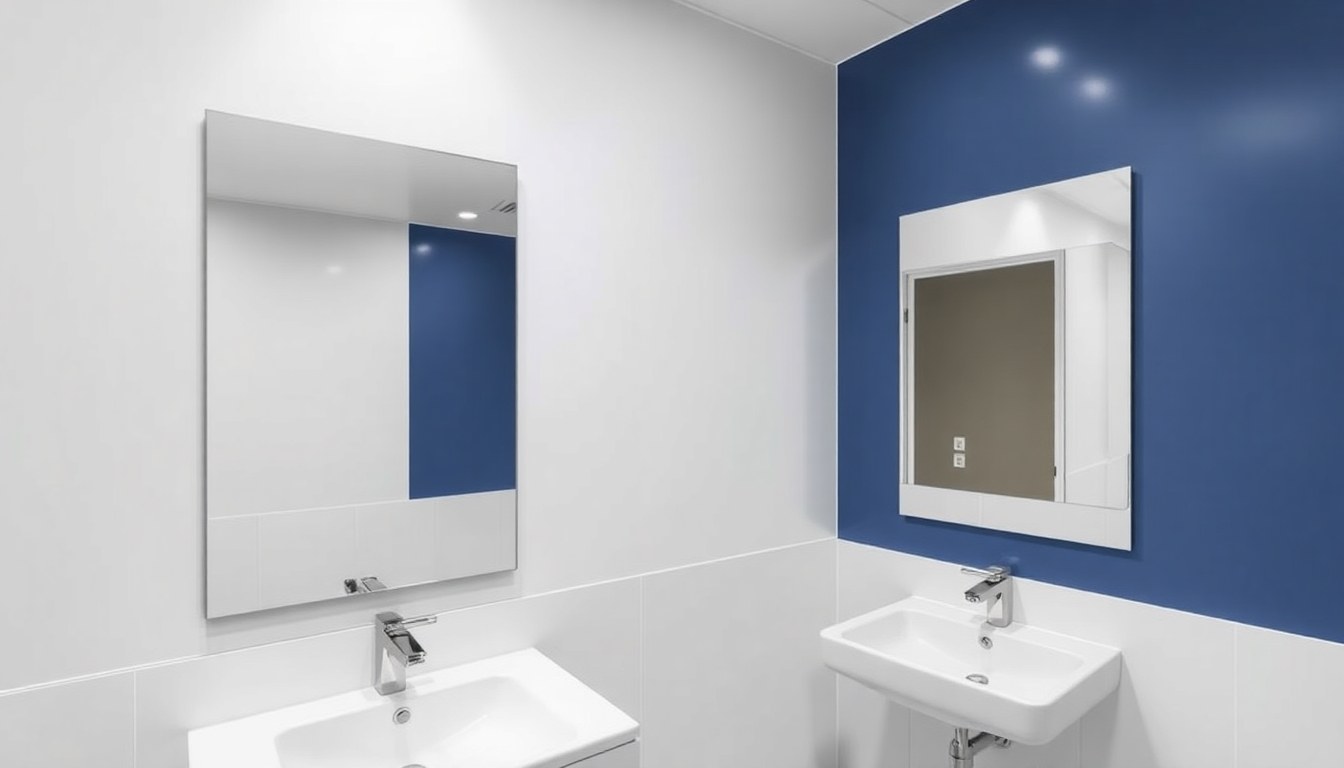
A 900 mm × 600 mm mirror in a 2.4 m × 1.8 m master bath with a rain-head and steam outlet fogs within ninety seconds of shower start. The client sees nothing, the architect fields the call, and the punch list grows. Resistive heating film — a 150-micron polymer pad bonded to the mirror back — raises the glass surface 4–6 °C above dew point and keeps condensation from forming. Spec it correctly and the mirror stays clear through a fifteen-minute steam shower; spec it poorly and you chase thermostat faults and RCP clashes at handover. Here's the engineered approach for Bangalore's monsoon-humidity baths.
Why Bangalore master baths fog faster than you expect
Cauvery water arrives at 200–300 ppm TDS, hard enough to leave calcium bloom on glass but not so aggressive that homeowners install whole-house softeners. During June–September monsoon months, ambient relative humidity in Malleshwaram and Sadashivanagar sits at 75–85 per cent before you turn on a shower. A rain-head delivering 15 litres per minute at 42 °C pushes bathroom air to near-saturation within two minutes. Any surface below dew point — mirror, tile, even the chrome spigot — condenses a film of water instantly.
Ventilation helps but rarely solves the problem. A 150 mm exhaust fan rated for 120 m³/h exchanges the air in a 10 m³ bath every five minutes, but the dew point inside the enclosure remains high until the shower stops. The mirror, mounted on the cooler exterior wall, stays below dew point and fogs. Heating the glass surface 4–6 °C above ambient breaks the condensation cycle. That's the job of resistive heating film.
Load calculation: matching wattage to mirror area and wall position
Heating film is sold by wattage per square metre. Standard residential spec is 150–200 W/m². A 900 mm × 600 mm mirror (0.54 m²) requires roughly 80–110 watts. Our engineered LED mirrors with integrated heating pads ship with film pre-bonded and load-rated; if you're retrofitting or working with a fabricator, you order film by the roll and cut to size minus a 25 mm border on all edges to avoid edge delamination.
Wall position matters. A mirror on an exterior-facing wall in a Jayanagar row house loses more heat than one on an interior partition. If the wall backs onto an air-conditioned bedroom, you may get away with 150 W/m². If it faces west and catches afternoon sun, the thermal gradient reverses and you can drop to 120 W/m² without performance loss. For steam-prone baths — anything with a steam generator or a rain-head run longer than ten minutes — spec 200 W/m² as the safe margin.
Voltage and circuit protection
Heating film runs on 230 V AC, single-phase. Draw for a typical 900 mm × 600 mm pad is 0.4–0.5 amps, well within a 6 A lighting circuit. That said, never share the circuit with LED downlights or exhaust fans; vibration and inrush current from fan start-up can trip a marginal connection in the film's terminal block. Call out a dedicated 6 A MCB on the RCP and label it "Mirror heating — do not combine with fan circuit." The electrician will thank you at rough-in.
Placement: bonding the film without trapping air
Heating film bonds to the mirror back with a pressure-sensitive adhesive — typically a 50-micron acrylic layer already laminated to the film. The mirror must be spotless: any dust particle, fingerprint oil, or sanding residue creates an air pocket that acts as an insulator and causes a hot spot. In a factory setting, the mirror is wiped with isopropyl alcohol, the film is laid from one edge, and a soft roller works out air bubbles in a single pass. On site, you don't have that luxury.
If you're coordinating a site-applied installation, insist on the following sequence in the shop drawing: (1) mirror cleaned with IPA and lint-free cloth, (2) film positioned with 25 mm clearance from all edges, (3) release liner peeled back 100 mm at a time while a plastic squeegee advances the bond line, (4) terminal leads dressed to one edge and strain-relieved with a 50 mm service loop, (5) mirror left flat for twenty-four hours before mounting. Any shortcut — peeling the whole liner at once, pressing by hand, mounting the same day — risks delamination within six months.
Edge clearance and moisture ingress
The 25 mm border is non-negotiable. Heating film that extends to the mirror edge wicks moisture into the adhesive layer, especially in Bangalore's monsoon months when a wet tile wall can push 95 per cent humidity into every joint. Once moisture enters, the adhesive softens, the film delaminates, and the pad stops heating uniformly. Mark the clearance on the shop drawing and call it out in the electrician handoff note.
Thermostat placement and the RCP handoff
Heating film is controlled by a wall-mount thermostat, typically a simple on/off switch with a pilot LED or a programmable unit with a remote sensor. The thermostat sits outside the splash zone — usually 1.5 m above finished floor, adjacent to the light switch — and the sensor, if separate, mounts on the mirror frame or the wall within 300 mm of the glass. The electrician needs three pieces of information on the RCP: (1) thermostat location with vertical and horizontal offsets from the door jamb, (2) conduit path from the switch to the mirror, and (3) whether the sensor is integral or remote.
Most architects call out a single-gang box for the thermostat and a 20 mm PVC conduit chased into the wall. If the mirror is surface-mount and the wall is already plastered, you can run the conduit externally in a corner and paint it to match, but that's a compromise. Better to coordinate rough-in before the first plaster coat. Mark the conduit termination point on the back of the mirror location — typically 100 mm from the top edge, centred — so the electrician knows where to leave the pull wire.
The electrician handoff note
At rough-in, the electrician pulls a three-core cable (live, neutral, earth) from the MCB to the thermostat box, and a two-core cable from the thermostat to the mirror termination point. The heating film's terminal block connects to the two-core at final fix, after the mirror is mounted. If you don't call this out explicitly, the electrician may assume the mirror arrives with a plug-and-socket arrangement (it doesn't) or that the film connects at the thermostat (it can't — the voltage drop over a 3-metre run would cost you 10 per cent of the heating power). Write it in the electrical note: "Run 2-core from thermostat to mirror back; terminate in junction box behind mirror; film connects at final fix."
Tolerance, testing, and the final punch list
Once the mirror is mounted and the film is wired, test the circuit before you hand over the bathroom. Switch on the thermostat, wait three minutes, and touch the glass surface. You should feel a 4–6 °C rise — warm to the touch but not hot. If the glass stays cool, check the terminal block for a loose connection. If one zone of the mirror heats and another doesn't, you've got an air pocket or a break in the resistive trace; that's a film replacement, not a field repair.
Condensation clearing time is the real test. Run the shower at 42 °C for five minutes, fog the mirror completely, then switch on the heating film. The fog should clear from the centre outward within ninety seconds. If it takes longer, the wattage is under-spec'd or the film isn't bonded uniformly. Either way, it's a punch-list item that needs resolution before you sign off.
Warranty and maintenance
Heating film carries a two-year warranty against manufacturing defects — delamination, trace failure, terminal-block corrosion. It does not cover damage from impact, over-voltage, or moisture ingress due to improper edge sealing. At handover, give the client a one-page maintenance note: do not spray glass cleaner directly onto the mirror edge, do not hang suction-cup accessories that press on the glass surface, and do not switch the thermostat on and off rapidly (the thermal cycling stresses the adhesive). Beyond that, the film is maintenance-free for the life of the mirror.
Integrating heating film with Bathqube LED mirrors
If you're spec'ing a Bathqube mirror — whether a backlit capsule unit or a minimal square mirror — the heating film is factory-bonded, load-tested, and wired to a single terminal block at the back. You don't cut film, you don't squeegee adhesive, and you don't chase the electrician for a junction box behind the mirror. The shop drawing shows the single conduit entry point, the thermostat location, and the two-core cable spec. The electrician pulls the cable, the installer mounts the mirror, and you connect the terminals at final fix. It's a fifteen-minute task, not a half-day coordination exercise.
The heating pad is sized to the mirror's active area — the zone inside the LED frame — so there's no wasted wattage heating the perimeter. For a 900 mm × 600 mm unit, expect a 70–90 watt load; for a 1200 mm × 800 mm unit, 120–150 watts. Both are within a single 6 A circuit. The thermostat is client-supplied (we don't bundle it because preferences vary — some architects want a programmable unit, others want a simple toggle), but we provide the terminal-block pinout and the recommended thermostat spec in the installation guide.
Questions architects ask
Can I retrofit heating film to an existing mirror?
Yes, but the mirror must come down, the back must be cleaned to optical grade, and the film must be bonded in a clean, dust-free space — not on site. If the mirror is builder-grade 4 mm float glass, it's often cheaper to replace it with a factory-finished Bathqube unit than to retrofit. If it's a custom-sized piece and the client insists on keeping it, send it to a glass fabricator with a clean room and a film supplier relationship. Budget two weeks for the round trip.
What happens if the thermostat fails?
The heating film stays off. The thermostat is the only active component; the film itself is a passive resistive element with no electronics. If the thermostat fails closed (rare), the film heats continuously until you trip the breaker. If it fails open (more common), the film never energises and the mirror fogs as if the system weren't there. Specify a thermostat with a pilot LED so the client knows at a glance whether the circuit is live.
Does heating film work with tinted or antiqued mirror glass?
Yes, but the bond strength depends on the back coating. Standard silver-backed mirror bonds reliably. Antiqued mirror with a painted or chemically treated back may not provide enough adhesion; test a sample before you commit to a full installation. Tinted mirror — bronze, grey, or low-iron — bonds without issue as long as the back is clean. If you're working with specialty glass, ask the fabricator for a peel-test result before you approve the shop drawing.
Can I run heating film on a 12 V DC circuit to match the LED driver?
No. Resistive heating film is designed for 230 V AC. To deliver the same wattage at 12 V DC, you'd need a current of 7–10 amps, which requires 4 mm² cable and a DC-rated MCB — neither of which is standard in a residential bathroom. The LED circuit and the heating circuit are separate; don't try to combine them. If the client wants a single switch for both, use a two-gang plate with independent circuits or a relay-based controller, but keep the supply voltages distinct.
How do I coordinate heating film with a frameless mirror that's direct-bonded to tile?
You can't. Heating film requires access to the mirror back for bonding and wiring. If the mirror is already bonded to tile with silicone or epoxy, there's no way to retrofit the film without removing the mirror — and removal usually means breakage. Specify heating film before the mirror goes up, or choose a framed or stand-off mount that leaves the back accessible. For direct-bond installations, accept that the mirror will fog, or spec an oversized exhaust fan and a longer ventilation run-time.
Spec a Bathqube mirror with integrated heating film for your next Malleshwaram or Sadashivanagar project, or request a shop drawing and RCP coordination note through the catalogue. We'll send you the load calculation, thermostat spec, and electrician handoff note within forty-eight hours.


