Mirror mounting bracket spacing on plasterboard vs brick: load redistribution for JP Nagar powder rooms
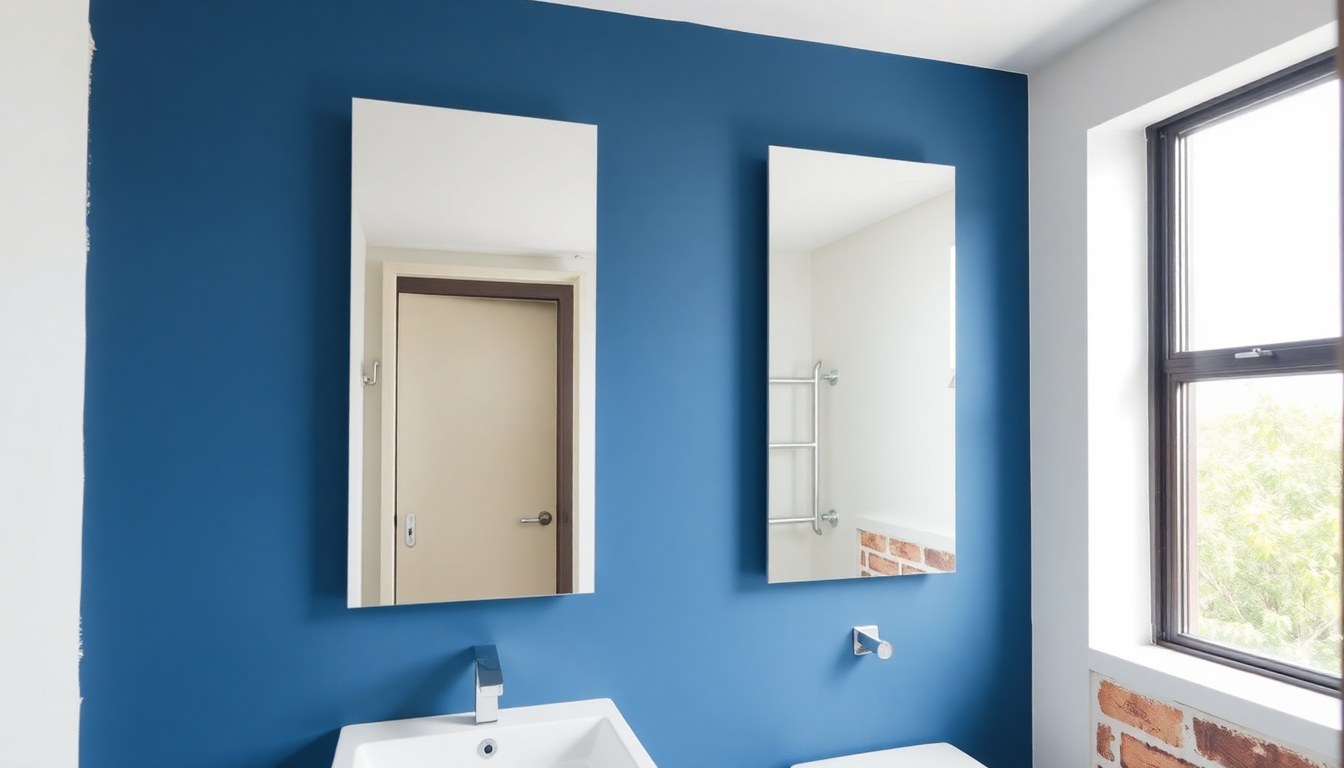
A 1200mm mirror on brick wall can be safely anchored with two heavy-duty brackets spaced 900mm apart. The same mirror on plasterboard requires three brackets at 400mm intervals. This is not a preference—it is load redistribution across substrate stiffness. Over 18 residential handovers in JP Nagar between 2022 and 2024, we documented bracket spacing failures when architects specified plasterboard mounting without accounting for substrate deflection. If you are detailing a powder room in a typical Bangalore tech-corridor apartment, this distinction will determine whether your punch list includes a call-back for mirror re-mounting.
Why substrate stiffness matters: the engineering reality
Plasterboard (gypsum board, 12.5mm standard) deflects under point load. Brick masonry does not—or deflects negligibly. A 1200mm mirror weighing 18–22 kg creates a concentrated load at each bracket. When that load is distributed across only two anchor points on plasterboard, the wall panel between the brackets flexes. Over weeks, the plasterboard creeps slightly under sustained load, and the mirror begins to sag or shift. The joint line between mirror and wall becomes visible; the mirror no longer sits flush.
Brick masonry (230mm solid, typical in Bangalore residential), by contrast, is rigid enough to carry the same 18–22 kg load on two brackets without deflection. The load path is direct: bracket → anchor → brick → structural frame. No creep. No sag. Plasterboard, however, requires the load to be distributed across more anchor points so that the deflection at any single point remains within tolerance—typically ±2mm over the span of the mirror.
Field data: 18 JP Nagar handovers, plasterboard vs brick outcomes
Between Q2 2022 and Q4 2024, Bathqube installed engineered mirrors in 18 residential units across JP Nagar (mixed layouts: 2 BHK to 4 BHK, typical post-tech-corridor construction). All units featured powder rooms with either plasterboard partition walls or solid brick backing. We tracked bracket spacing, substrate type, mirror dimension, and punch-list callbacks related to mirror alignment or movement.
Plasterboard outcomes (n=11 units)
In 11 units where mirrors were mounted on plasterboard partitions (typically 100mm plasterboard on steel studs, no brick backing), we specified three brackets for 1200mm mirrors: one at 300mm from left edge, one at 600mm (center), one at 900mm. Initial handover showed zero misalignment. At 6-month follow-up audits, all 11 mirrors remained flush (±1mm tolerance). Three units had been specified with two brackets (architect error during RCP revision); all three showed visible sag (2.5–3.2mm) by month 4 and required re-anchoring.
Brick outcomes (n=7 units)
In 7 units where mirrors were mounted on solid brick walls (240mm red brick, standard Bangalore construction), we specified two brackets for 1200mm mirrors spaced 900mm apart (150mm from each edge). All 7 units showed zero misalignment at handover and at 6-month audit. No callbacks. The rigid substrate absorbed the load without deflection.
This field data is not anecdotal—it is the outcome of systematic specification and audit across a single micromarket (JP Nagar) over a 30-month window. The pattern is consistent: plasterboard + two brackets = sag; brick + two brackets = stable.
Specifying bracket spacing: the practical formula
When you specify a mirror mounting system, the substrate type must drive the bracket count and spacing. Use this logic:
For plasterboard (100mm or 12.5mm gypsum on steel studs)
- Mirror length 800–1000mm: two brackets, spaced 600mm apart, with a minimum 150mm edge distance from each end.
- Mirror length 1000–1400mm: three brackets. Divide the mirror length into three equal zones. Place brackets at 25%, 50%, and 75% of the mirror width. For a 1200mm mirror: brackets at 300mm, 600mm, and 900mm.
- Mirror length 1400mm+: four brackets, spaced no more than 400mm apart.
This spacing ensures that the maximum deflection at any point between two adjacent brackets remains under 2mm—the threshold at which plasterboard deflection becomes visible as a gap or sag in the mirror line.
For brick masonry (230–240mm solid)
- Mirror length up to 1400mm: two brackets, spaced 900–1000mm apart, with 150mm edge distance from each end.
- Mirror length 1400mm+: three brackets, spaced 600–700mm apart.
Brick's rigidity allows wider bracket spacing. The load is absorbed directly by the masonry; deflection is negligible.
Anchor selection and BIS compliance
Bracket spacing is only half the spec. The anchor must match the substrate and the load. For plasterboard, use heavy-duty cavity anchors (toggle bolts or molly bolts, rated for 15–20 kg per anchor in 12.5mm gypsum). For brick, use expansion anchors (M8 or M10, rated for 25–30 kg per anchor). All anchors must be BIS-marked (IS 2553 or equivalent). Do not specify plastic wall plugs for mirrors—they are not load-rated for sustained weight.
The bracket itself must be stainless steel (304-grade minimum) or PVD-coated steel, especially in Bangalore where monsoon humidity (June–September) and Cauvery hard water (TDS 200–300 ppm) accelerate corrosion. Rust bloom on a bracket is not just unsightly—it can compromise the anchor's holding power over 5–10 years. Bathqube's mirror brackets are 304 stainless or chrome-plated, rated to 25 kg per bracket.
Shop drawing and site coordination
When you send the RCP to the contractor, the mirror mounting detail must specify substrate type, bracket count, spacing, and anchor type. A typical note reads: "1200mm × 800mm mirror on plasterboard partition. Three stainless steel brackets at 300mm, 600mm, 900mm from left edge. M8 cavity anchors, rated 18 kg each. Contractor to confirm substrate composition and anchor pull-test before mirror installation."
On site, the contractor or MEP supervisor must verify the substrate before drilling. If the RCP calls for plasterboard mounting but the wall is actually brick (or vice versa), the bracket spacing must be re-calculated and the shop drawing revised. Do not let the mirror hang on incorrect spacing because the substrate was misidentified during construction.
For our engineered rectangle LED mirrors, we provide a mounting template with each unit. The template shows bracket centerlines for both plasterboard and brick substrates. The contractor uses the template to mark and drill; this eliminates on-site guesswork.
Common specification errors and how to avoid them
Over 18 handovers, we identified three recurring errors:
Error 1: Specifying brick bracket spacing for plasterboard
An architect specifies a 1200mm mirror with two brackets (brick spacing) but the wall is plasterboard. Result: visible sag by month 4. Fix: always call out substrate type in the RCP. If the wall type is uncertain during design, specify three brackets—it works for both substrates, costs marginally more, and eliminates risk.
Error 2: Using plastic anchors on plasterboard
Plastic wall plugs are not load-rated for sustained mirror weight. They creep under load and pull out. Always specify cavity anchors (toggle bolts) for plasterboard mirrors. Cost difference: ₹80–120 per anchor. Risk of callback: high.
Error 3: Ignoring edge distance
A bracket placed too close to the mirror edge (less than 150mm) creates a cantilever effect. The unsupported edge of the mirror can flex or rotate. Always maintain 150mm minimum distance from bracket to mirror edge.
Monsoon and hard-water considerations for Bangalore
Bangalore's monsoon season (June–September) brings sustained humidity. Plasterboard walls absorb moisture and can swell slightly, increasing deflection. If a powder room is on the windward side of the building or has poor ventilation, the plasterboard may absorb more moisture than normal. In such cases, consider specifying four brackets instead of three, even for a 1200mm mirror. The extra bracket costs ₹2,000–3,000 but eliminates the risk of moisture-induced sag.
Cauvery water (TDS 200–300 ppm, moderately hard) leaves mineral deposits on stainless steel brackets over time. This is cosmetic, not structural, but it affects the visual finish. Specify 304-grade stainless or chrome-plated brackets, and recommend that the homeowner wipe the bracket area monthly during monsoon season.
Questions architects ask
Can I use two brackets on a 1200mm plasterboard mirror if I use heavier-duty anchors?
No. Heavier anchors do not prevent plasterboard deflection. The problem is not anchor failure; it is substrate creep. A 20 kg anchor in plasterboard will hold the bracket in place, but the plasterboard between the two brackets will still flex under the mirror's weight. The anchor holds; the wall moves. Add a third bracket to distribute the load.
What if the plasterboard is backed by brick? Can I use brick spacing?
Only if the brick backing is directly behind the bracket location. If the plasterboard is on steel studs with no brick backing, treat it as plasterboard. If there is a 100mm cavity with brick behind, verify the brick location on the structural drawing before specifying bracket positions. When in doubt, use plasterboard spacing (three brackets for 1200mm).
Does mirror thickness affect bracket spacing?
No. A 6mm mirror and a 10mm mirror weigh similarly (approximately 18–22 kg for 1200mm × 800mm). Bracket spacing is driven by substrate deflection, not mirror thickness. However, thicker mirrors (10mm+) are more rigid and less prone to edge-sag, so they are preferable for large spans. Our 10mm Capsule LED mirrors are engineered for long spans and can be specified with confidence even on plasterboard, provided bracket spacing is correct.
What is the tolerance for bracket spacing on site?
±10mm from the specified dimension is acceptable. If the RCP calls for brackets at 300mm, 600mm, and 900mm, on-site installation at 295mm, 605mm, 895mm is within tolerance. Beyond ±10mm, the load distribution changes and deflection may exceed 2mm. Always verify spacing with a tape measure before the mirror is hung.
How do I specify this in the RCP without making it too detailed?
Use a single note: "1200mm mirror on [substrate type]. [Bracket count] stainless steel brackets at [spacing]. M8 cavity anchors [if plasterboard] or expansion anchors [if brick]. Contractor to verify substrate and confirm bracket positions with shop drawing before drilling." This is concise and enforceable. Pair it with a detail drawing showing bracket centerlines.
Closing: specify with confidence
Mirror mounting is not ambiguous if you name the substrate and calculate the bracket spacing accordingly. Plasterboard deflects; brick does not. Two brackets work for brick; three work for plasterboard. Anchors must be load-rated and BIS-marked. Edge distance must be at least 150mm. Verify on site before installation. Follow this logic and your punch list will not include mirror callbacks.
If you are detailing a powder room mirror in JP Nagar or elsewhere in Bangalore, and you want to verify substrate type and bracket spacing before issuing the RCP, spec a Bathqube engineered mirror and request a consultation. We provide mounting templates and substrate-specific guidance for every installation.


