Bathroom mirror demister pad sizing: watts per sq ft for a 36×24 inch Sadashivanagar mirror
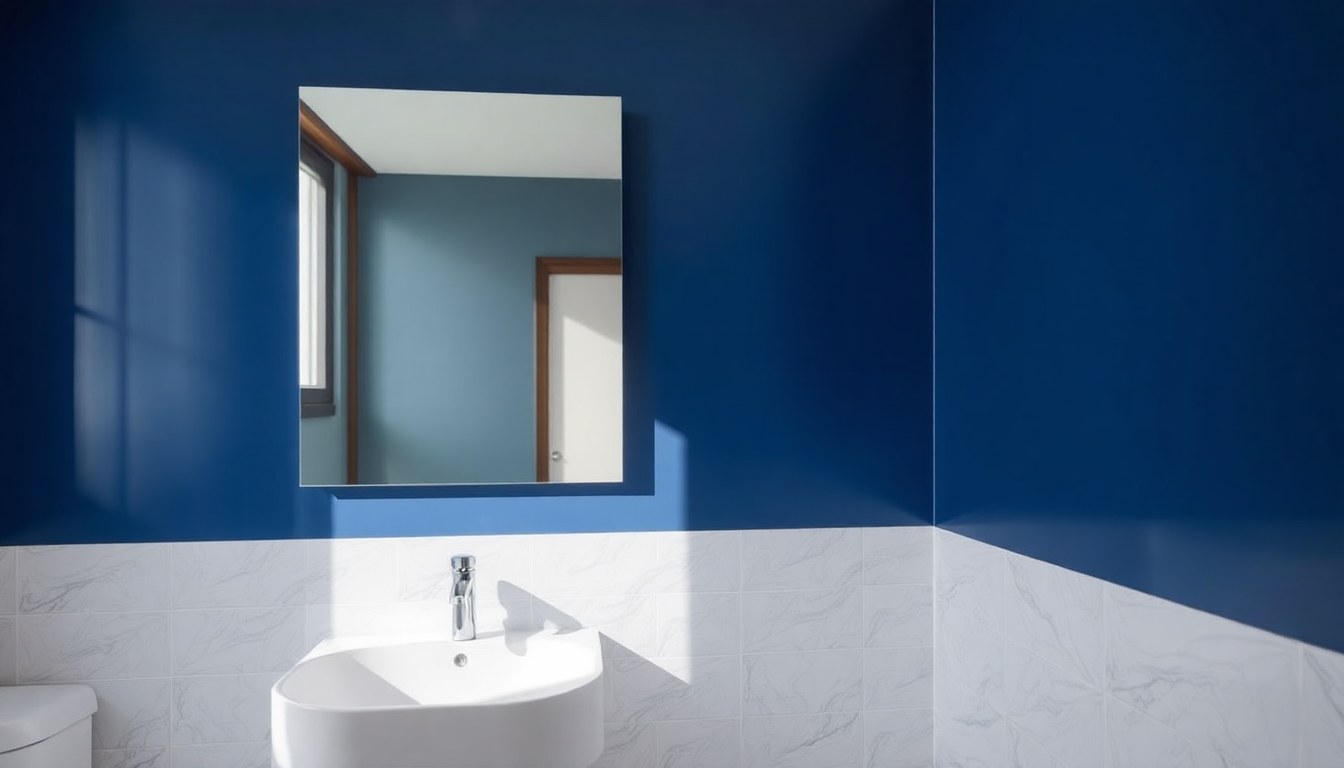
A 36×24 inch backlit mirror in a Sadashivanagar master-bath shows condensation bloom within ninety seconds of shower start, even with the ceiling exhaust running. The architect specified a demister pad during shop-drawing review, but the electrical contractor asked for wattage, film dimensions, and whether the pad shares the LED driver circuit or requires a separate switched line. These are not catalogue footnotes — they are site-coordination questions that determine whether the mirror clears on handover or becomes a punch-list liability through two monsoons.
Why demister pads matter in Bangalore's June-to-September humidity
Bangalore's monsoon months deliver indoor relative humidity between 70 and 85 percent. A hot shower in an enclosed bath pushes local humidity above 95 percent within minutes. When warm, moisture-laden air meets a mirror surface cooled by air-conditioning or an exterior wall, water vapor condenses instantly. The mirror fogs. Ventilation helps, but unless the exhaust fan moves more than twelve air changes per hour — rare in residential projects — condensation outruns airflow during the first five minutes of use.
Demister pads are thin resistive heating films, typically PET-substrate with etched conductive traces, that bond to the back of the mirror glass. Powered, they raise the mirror surface temperature three to five degrees Celsius above ambient, enough to prevent condensation without creating a hot spot visible from the front. The pad does not defog an already-condensed mirror quickly; it prevents fog from forming in the first place. Architects specify them on backlit mirrors in master baths, powder rooms with poor ventilation, and any bath where the mirror backs onto an exterior wall common in Whitefield and Sarjapur Road projects with large glazed facades.
Calculating pad area for a 36×24 inch mirror
A 36×24 inch mirror has a face area of 864 square inches, or exactly six square feet. Demister pads are sized smaller than the mirror itself — the heating film typically covers 70 to 80 percent of the mirror back, leaving a two-inch unheated perimeter to avoid edge hot-spots and to clear the mounting cleat or channel. For a 36×24 inch mirror, the pad dimensions are usually 32×20 inches, yielding 640 square inches or 4.4 square feet of heated area.
Heating film is sold in standard rectangles: 12×18, 16×20, 20×24, 24×32, and 30×40 inches. A 32×20 inch pad fits within the 36×24 inch mirror back with margin to spare. If the mirror frame or mounting hardware occupies more back-surface area — common with our capsule LED mirror in 36×24 inch format where the driver and junction box sit behind the top rail — the pad may drop to 28×18 inches, or 3.5 square feet. Confirm the as-built back-surface clearance before ordering the film; a pad that overlaps a mounting cleat will delaminate or short.
Wattage density and total load
Demister pads are rated by wattage per unit area, typically five to seven watts per square foot. A 4.4 square foot pad at six watts per square foot draws 26.4 watts. Round to 30 watts for circuit sizing. A 3.5 square foot pad at the same density draws 21 watts. These are negligible electrical loads — less than a single LED downlight — but they must appear on the lighting schedule and the electrical single-line diagram because they require a switched 230V AC line.
Some architects specify higher-density pads — eight or nine watts per square foot — for baths with exterior walls or skylights where the mirror surface runs colder. We have not found this necessary in Bangalore; six watts per square foot clears condensation reliably even in Hebbal and Yelahanka projects where morning temperatures drop to sixteen degrees Celsius in January. Higher wattage increases the risk of a visible hot spot if the pad is undersized or misaligned during installation.
Switch wiring: shared circuit or dedicated line?
The demister pad requires 230V AC. It cannot share the low-voltage LED driver circuit. The question is whether it shares the mirror-light switch or gets a separate switch. Most architects prefer a single switch that powers both the LED perimeter and the demister pad simultaneously — the user turns on the mirror, and both elements energize. This requires a dual-load switch or a relay: the switch closes the LED driver circuit and the demister pad circuit in parallel.
The wiring is straightforward. The incoming 230V line splits at a junction box behind the mirror. One branch feeds the LED driver (which steps down to 12V DC for the LED strip). The other branch feeds the demister pad directly. Both branches return to the switch. When the switch closes, both loads energize. The combined load is typically 35 to 50 watts: 20 to 25 watts for the LEDs, 25 to 30 watts for the pad. A standard 6A switch handles this comfortably.
Dedicated switch for high-use scenarios
In some Indiranagar and Koramangala apartments, the client wants the mirror light on for ambient illumination without running the demister — for instance, during evening grooming when no shower is imminent and condensation is not a concern. Here, specify a two-gang switch: one for the LEDs, one for the pad. The pad switch is labeled "demister" or marked with a defog icon. The client turns it on five minutes before showering, and leaves it on until the bath cools. This arrangement adds a switch and a wire run, but it saves energy in households where the mirror light runs for hours daily.
For projects with home automation, the demister pad can be wired to a humidity sensor or a shower-occupancy sensor. When the sensor detects humidity above 70 percent or motion in the shower zone, it energizes the pad. When humidity drops or the shower is vacant for ten minutes, it cuts power. This is common in Sadashivanagar and Jayanagar villas where the lighting control system already includes environmental sensors. The pad's low wattage makes it a negligible addition to the automation load schedule.
Installation notes for the site electrician
The demister pad arrives as a thin film with a self-adhesive back and a two-wire pigtail. The installer peels the release liner and presses the film onto the clean, dry back surface of the mirror, centered within the unobstructed area. The adhesive is pressure-sensitive; once bonded, the film cannot be repositioned without tearing. Mark the pad location on the mirror back with a pencil before peeling the liner.
The pigtail exits the pad at one corner. Route it to the junction box, avoiding sharp bends that can fracture the conductor. The pigtail is usually 150mm long; if the junction box is farther, splice the pigtail to a longer wire using a twist connector or a terminal block inside the box. Do not solder directly to the pigtail unless the pad datasheet permits it — excess heat can delaminate the film substrate.
Once wired, test the pad before mounting the mirror. Power the circuit and wait three minutes. Touch the pad surface; it should feel warm but not hot — approximately 35 to 40 degrees Celsius. If the pad does not warm, check polarity (though most pads are non-polar) and continuity. If the pad overheats or smokes, de-energize immediately and check for a short or incorrect voltage. Mount the mirror only after verifying that the pad heats evenly and that the LED circuit operates independently if switched separately.
Tolerance and edge clearance
Leave at least 40mm clearance between the pad edge and any mounting hardware — cleats, clips, or the back rail of a framed mirror. Pads that overlap metal hardware can short if the film edge frays or if moisture bridges the gap during installation. For mirrors with rear-mounted junction boxes, as on our rectangle LED mirror with integrated driver housing, confirm that the box does not obstruct more than 15 percent of the available back surface; otherwise, the pad area drops below the minimum effective coverage and condensation will form in the unheated zones.
Edge clearance also matters for thermal expansion. Glass expands approximately 9 micrometers per meter per degree Celsius. A 36-inch-wide mirror heated five degrees will expand roughly 0.4mm across its width. The pad, bonded to the glass, expands with it. If the pad extends to the very edge of the glass, repeated thermal cycling can cause edge delamination. A 50mm unheated perimeter absorbs this movement without stressing the adhesive bond.
Cost and lead time
Demister pads sized for residential mirrors cost between ₹800 and ₹1,800 depending on area and wattage density. A 32×20 inch pad at six watts per square foot typically falls around ₹1,200. Lead time is two to three weeks if ordered separately; if specified during mirror fabrication, the pad is bonded at the factory and the lead time remains the same as the mirror itself — usually four weeks for a backlit unit. Factory bonding is preferable; it ensures correct alignment and eliminates the risk of site contamination (dust, fingerprints, moisture) that can compromise adhesive performance.
Include the pad cost in the mirror line item on the BOQ, not as a separate electrical item. The pad is a mirror accessory, like the LED driver or the hanging cleat. Listing it separately invites value-engineering pressure from the builder, and the architect loses control over whether it gets installed. When the pad is part of the mirror specification, it arrives bonded and prewired, and the electrician simply connects the pigtail to the switch circuit during rough-in.
Questions architects ask
Can I add a demister pad to an existing mirror already installed?
Technically yes, but it requires removing the mirror, bonding the pad to the back, routing the pigtail to the junction box, and reinstalling the mirror. The risk of breakage during removal is high, especially with glued mirrors or mirrors mounted on uneven tile. It is almost always more practical to replace the mirror with a new unit that has the pad factory-bonded. If the existing mirror is a standard size — 24×36, 30×40 — replacement is straightforward. Custom shapes or beveled edges complicate replacement and may justify the retrofit risk.
Does the demister pad work if the mirror is cold-mounted against an exterior wall?
Yes, but the pad must be slightly higher wattage — seven or eight watts per square foot instead of six — because the exterior wall acts as a heat sink, drawing warmth away from the mirror back. Confirm that the wall cavity is insulated; an uninsulated exterior wall in a Devanahalli or Hennur project will defeat even a high-wattage pad. If the wall is uninsulated, consider specifying a thicker mirror — 6mm instead of 4mm — to reduce the thermal bridge, or relocate the mirror to an interior wall.
How long does the demister pad take to prevent condensation after the shower starts?
If the pad is already energized when the shower starts, condensation will not form. If the pad is switched on simultaneously with the shower, it takes two to three minutes to raise the mirror surface temperature above the dew point. For best results, wire the pad to energize when the bath light is turned on, so it is already warm before the shower starts. This is the default configuration for single-switch installations.
What happens if the demister pad fails after handover?
Pad failure is rare — the film has no moving parts and operates well below its thermal limit — but if it does fail, the symptom is a mirror that fogs normally. The LED circuit will continue to work because it is independent. Replacement requires removing the mirror, peeling off the old pad, bonding a new pad, and reinstalling. If the mirror is within its warranty period and the pad was factory-bonded, the mirror supplier typically replaces the entire unit. If the pad was field-installed, the installer is responsible. This is another reason to specify factory bonding: warranty clarity.
Can I use a demister pad on a mirror larger than 40 inches wide?
Yes, but you may need two pads placed side by side, with their pigtails wired in parallel to a single circuit. A 48×36 inch mirror, for instance, would use two 24×32 inch pads. The combined wattage is around 50 to 60 watts, still within the capacity of a standard switch. Ensure the pads do not overlap — leave a 10mm gap between them — and that their edges remain at least 50mm from the mirror perimeter. For very large mirrors — 60 inches or wider, common in Jayanagar and Basavanagudi heritage homes with oversized baths — consult the pad manufacturer for a custom-cut film or a higher-wattage single pad.
Bathqube mirrors are engineered with demister pad provisions on all backlit models 24 inches and larger. Spec a mirror for your next Bangalore project through the online configurator, or request a shop drawing with pad dimensions and wiring notes for coordination with your electrical consultant.


