Vanity countertop overhang vs drawer clearance: the 25mm tolerance for Banashankari modular units
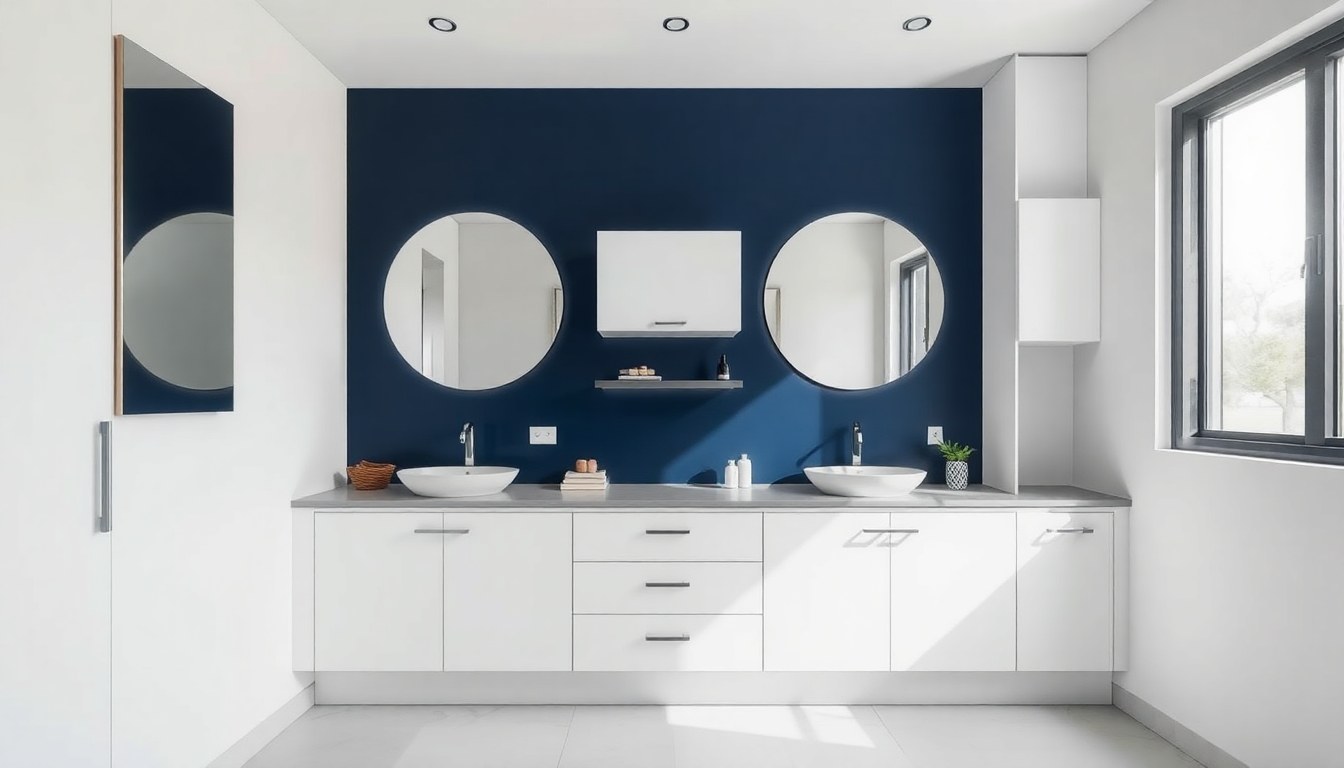
A 40mm countertop overhang and a 480mm drawer box leave 25mm clearance—enough for a D-pull, not enough for a bar handle. That dimension gets missed in handoff drawings more often than any other, and the punch list always reads the same: "drawer won't close, handle fouls on wall." If you're specifying modular vanities for Banashankari row-house bathrooms—where the 900mm width is fixed and the millwork arrives before the stone—you need a dimensional checklist that coordinates projection, box depth, and hardware before the shop drawing goes to fab.
Why countertop overhang is not arbitrary
Countertop projection serves two functions: it protects the cabinet face from water drip, and it provides knuckle clearance when you pull a drawer. The BIS handbook on modular kitchen furniture (SP 6:2004) recommends 25–40mm overhang for horizontal work surfaces; the same range applies to bathroom vanities. In Bangalore projects, 40mm is standard because Cauvery hard water leaves visible calcite trails on cabinet fronts if the drip line falls short of the door edge.
But that 40mm is measured from the cabinet box face, not the finished wall. If your millwork supplier builds to the nominal 600mm depth and you add 40mm projection, the total footprint is 640mm—fine in a 1200mm-deep bathroom, tight in the 900mm ensuites common to Banashankari and Basavanagudi layouts. The real constraint is the gap between drawer front and back wall: you need at least 20mm for a flush D-pull, 35mm for a bar handle with rear standoff, and 50mm if the client insists on a recessed grip channel.
Drawer box depth and the 25mm rule
Most modular vanity systems use 450mm or 480mm drawer boxes—the former for soft-close runners rated to 20kg, the latter for heavy-duty tandem slides that carry 30kg of towels and toiletries. Add a 19mm drawer front and you're at 469mm or 499mm total depth. Subtract that from a 600mm cabinet carcass and you have 131mm or 101mm remaining—except the carcass itself has an 18mm back panel, so the usable gap is 113mm or 83mm.
Now apply the countertop overhang. A 40mm projection eats into that gap, leaving 73mm or 43mm between the drawer front (when closed) and the back wall. If the handle projects 18mm from the drawer face and has a 12mm rear standoff, you need 30mm minimum clearance. A 43mm gap is workable; a 25mm gap means the handle fouls. This is the tolerance architects miss when they approve a vanity elevation without checking the section.
The millwork handoff checklist
Before you release a shop drawing, verify four dimensions in sequence:
- Cabinet carcass depth: 600mm is nominal; confirm whether that's internal or external, and whether the back panel is inset or overlay.
- Drawer box depth: 450mm for standard runners, 480mm for tandem slides. Add 19mm for the applied front.
- Countertop overhang: 40mm from cabinet face is standard; 50mm if you're using a thick-edge profile (25mm laminate + 25mm build-up).
- Handle projection + standoff: measure from the drawer front surface to the rearmost point of the mounting screw or backplate.
The sum of drawer-box depth, front thickness, overhang, and handle standoff must be less than the bathroom depth minus 50mm (for baseboard and wall finish). If it isn't, you have three levers: reduce the drawer box to 450mm, trim the overhang to 30mm, or specify a flush D-pull.
Coordinating stone and millwork lead times in Bangalore
Countertop overhang becomes a site issue when the stone template happens before the cabinet is installed. In Whitefield and Sarjapur Road projects, the typical sequence is: millwork fabrication (3 weeks), cabinet install (1 day), stone template (next day), stone cutting and polishing (1 week), stone install (half day). If the template drawing assumes a 40mm overhang but the as-built cabinet has a 19mm applied front that wasn't in the shop drawing, the stone arrives 21mm short.
Bathqube vanity tops are engineered glass, not stone, and they're factory-finished to the shop drawing dimension—but the same coordination problem applies. The configurator asks for cabinet width, countertop projection, and cutout location; if those dimensions come from an RCP that doesn't match the millwork as-built, the top won't align. The fix is to template after cabinet install, not before, and to send the millwork supplier's final shop drawing (with drawer-box depth and front thickness) to the glass fabricator.
Why 25mm tolerance matters in narrow bathrooms
Banashankari row houses and Jayanagar BDA layouts often have 900mm-deep bathrooms—just enough for a 600mm vanity, a 250mm circulation gap, and a 50mm wall finish. In those projects, every millimetre of the vanity footprint is spoken for. A 40mm overhang plus a 480mm drawer box plus a 35mm bar handle totals 555mm; add the 18mm back panel and you're at 573mm, leaving 327mm to the back wall. That's tight but workable.
But if the countertop supplier adds an extra 10mm to the overhang "for safety," or the millwork shop uses a 500mm tandem slide because that's what's in stock, the total jumps to 583mm and the handle fouls. The 25mm tolerance isn't a design preference—it's the arithmetic gap between a vanity that works and one that doesn't close.
Handle selection and rear clearance
Handle hardware introduces the most variability. A flush D-pull (12mm projection, no rear standoff) needs 15mm clearance. A bar handle with concealed screws (18mm projection, 10mm standoff) needs 30mm. A recessed channel routed into the drawer front needs 50mm because the finger recess is 30mm deep and you need 20mm knuckle clearance behind it.
In Indiranagar and Koramangala apartments, where the ensuite is often 1200×1800mm, you can specify any handle you like. In Banashankari and Basavanagudi, where the bathroom is 900×1500mm, you're limited to D-pulls or edge-mount profiles. The architect's job is to call that constraint early—before the client falls in love with a 40mm-diameter bar handle that won't fit the section.
PVD-coated pulls and humid-season corrosion
Bangalore's monsoon humidity (June through September) accelerates tarnish on uncoated brass and zinc-alloy pulls. Bathqube specifies PVD-coated stainless steel or solid brass with a 3-micron PVD finish for all vanity hardware; the coating is scratch-resistant and won't pit under 200–300 ppm TDS exposure. If you're sourcing handles separately, verify the finish spec—"chrome-plated" usually means electroplated zinc alloy, which shows rust bloom within six months in a Cauvery-water zone.
Shop drawing markup: what to red-line before fab
When you receive a millwork shop drawing, mark up the section view, not just the elevation. Red-line these five items:
- Carcass depth (internal): should be 582mm if the nominal spec is 600mm and the back panel is 18mm overlay.
- Drawer box depth: confirm runner type (undermount soft-close vs. tandem slide) and box dimension (450mm or 480mm).
- Drawer front thickness: 19mm is standard for laminate-wrapped MDF; 22mm if it's veneered ply.
- Countertop overhang: call out the dimension from cabinet face, not from wall; specify whether it's uniform or stepped back at the side splash.
- Handle centre + projection: dimension from top edge of drawer front to handle centre, and from drawer face to rear standoff point.
If any dimension is missing, the shop will assume a default—and the default is usually wrong. The 25mm tolerance exists because five small assumptions (each off by 5mm) compound into a 25mm error at handover.
Bathqube vanity coordination: glass top to millwork base
Bathqube vanity tops are 12mm toughened glass with a polished edge and a CNC-cut basin aperture. The top is templated to your shop drawing: you send us the cabinet width, projection, side-splash height, and cutout location, and we fabricate to ±1mm tolerance. The glass sits on a 3mm EPDM gasket adhered to the cabinet top rail; no silicone, no mechanical fasteners.
The coordination point is the cutout. If your shop drawing shows a 480mm drawer box and a 40mm overhang, we'll position the basin cutout 520mm from the back edge of the glass (480mm + 40mm). If the as-built cabinet has a 500mm box, the basin sits 20mm forward of where the plumbing rough-in expects it, and the trap doesn't align. The fix is to template after cabinet install and to send us a site photo with a tape measure across the box depth.
Why glass tolerates dimensional variance better than stone
Engineered glass has a coefficient of thermal expansion about half that of granite (8×10⁻⁶ /K vs. 16×10⁻⁶ /K), which means it's less prone to edge spalling when the countertop edge doesn't land perfectly on the cabinet rail. A 2mm gap between glass and rail is invisible under the EPDM gasket; a 2mm gap under a stone slab shows as a visible cant. That tolerance margin is why Bathqube can template to a shop drawing with confidence—but only if the drawing matches the as-built cabinet.
Questions architects ask
Can I reduce countertop overhang to 30mm to gain drawer clearance?
Yes, but you'll need to detail a drip groove on the underside of the glass, 10mm from the front edge, to prevent water from tracking back onto the cabinet face. A 30mm overhang without a drip groove will stain the drawer fronts within three months in a Cauvery-water zone. Bathqube can CNC-mill a 3mm drip channel on the underside at no surcharge if you call it out in the configurator notes.
What's the minimum clearance for a soft-close undermount runner?
20mm from the back of the closed drawer front to the wall surface. That allows the runner's damper piston to compress fully without the handle fouling. If you're using a bar handle with a 10mm rear standoff, you need 30mm total clearance, which means a 450mm drawer box, not 480mm, in a 600mm cabinet with 40mm overhang.
How do I coordinate the basin cutout if the vanity is wall-hung?
Wall-hung vanities have no back panel, so the drawer box depth is the only constraint. Measure from the wall surface to the front face of the closed drawer, add the handle standoff, and subtract that sum from the cabinet depth. The remainder is your maximum basin depth. For a 600mm wall-hung cabinet with a 480mm drawer and 40mm overhang, you have 80mm available—enough for a semi-recessed basin, not enough for a fully recessed one.
Can I template the countertop before the cabinet is installed?
Only if the millwork shop drawing has been red-lined and approved, and the drawer box depth, front thickness, and overhang are locked. Even then, we recommend templating after install, because site dimensions (wall out-of-plumb, floor slope) often force the installer to shim or scribe the cabinet, which shifts the countertop datum by 5–10mm. Glass is cut to ±1mm; a 10mm shift means the top won't sit square.
What happens if the handle fouls after handover?
You have two fixes: replace the handle with a flush D-pull (18mm projection, no standoff), or trim the countertop overhang and re-polish the edge. The second option costs ₹1,200–1,500 per linear metre for glass; stone is similar. The first option costs ₹400–600 per handle. Either way, it's a punch-list item that could have been caught in the shop-drawing review.
Spec a Bathqube vanity top by sending us your millwork shop drawing—we'll coordinate the cutout, overhang, and edge profile to the as-built cabinet and deliver a factory-finished glass top with a 10-year warranty. Request a configurator quote through the catalogue or email your section detail to our Bangalore studio.


